Birding window
Bosque del Apache
Two dawns and two dusks on the Middle Rio Grande
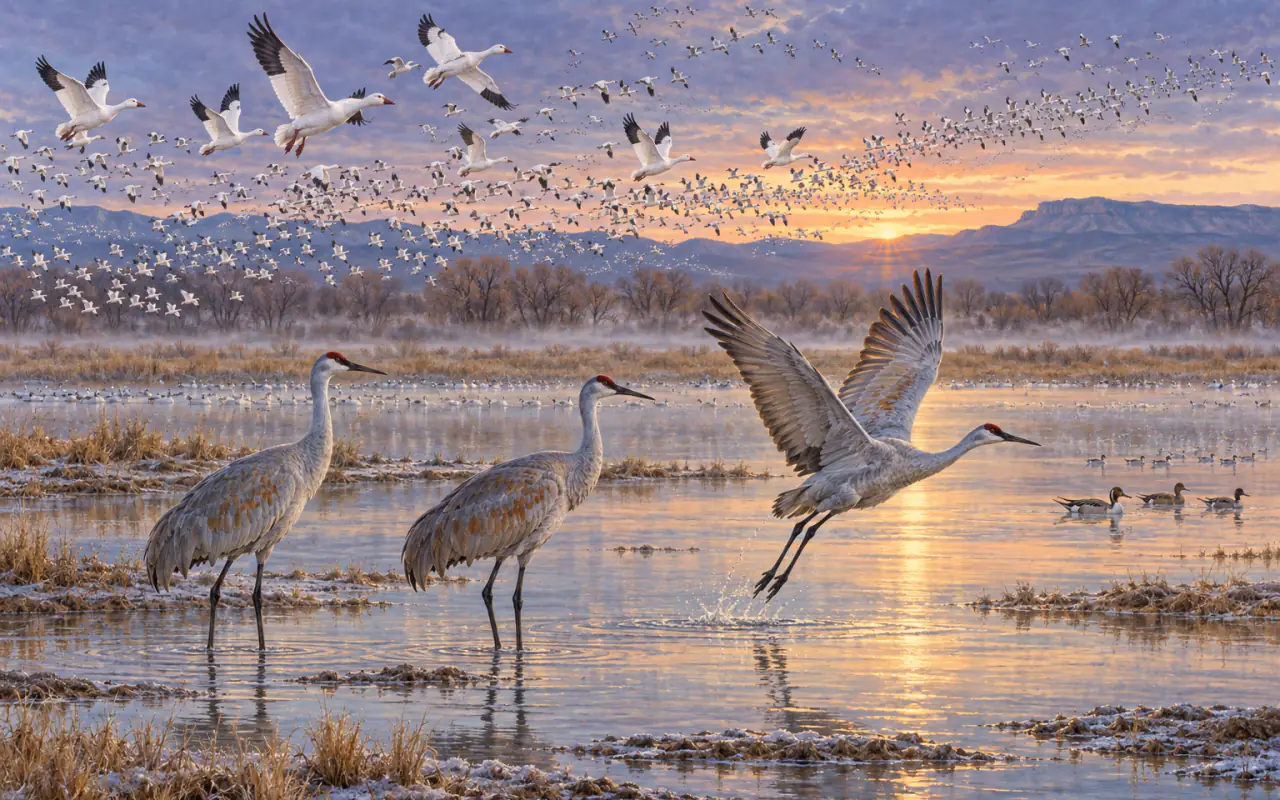
The geese leave in one sheet and the cranes follow in family groups, twice a day, all winter. The hard part is not finding the refuge. It is knowing which water the birds are using this week — and that answer moves.
Bosque del Apache is not a wilderness that happens to have birds in it. It is a working floodplain on the Middle Rio Grande — wetland units, farm fields, ditches, gates and wells — flooded and drained on a schedule set by the water year, and the cranes and geese follow that schedule rather than the map in your hand. This is a plan for two nights, built on one habit: ask the refuge where the water is, then go and stand at it in the dark.
At a glance
Planning the trip
- Give it
- Two nights, three days. That buys two dawns and two dusks, which is the minimum that lets you correct a mistake. Arrive by early afternoon on day one — the visitor centre closes at four, and the evening flight is the same day.
- Base in
- Socorro. It is the only town with a real choice of rooms and food, and it is about twenty minutes north of the refuge gate on I-25 and NM-1. San Antonio, the village at exit 139, is nearer and smaller. Nothing on the refuge is open at night and there is no lodging inside it.
- Fly into
- Albuquerque (ABQ) and drive. It is roughly ninety miles and an hour and a half to the refuge, almost all of it interstate. There is no useful commercial service nearer, and no transit worth the name once you arrive.
- Car
- Essential, and it is also your blind. The Auto Tour Loop is a wide gravel road and the birds are used to vehicles; they are not used to people standing next to vehicles. Most of the best watching happens with the engine off and you still in the seat.
- Fees
- Five dollars a day for a private vehicle, cash, check or card. A Bosque del Apache annual pass is fifteen dollars and pays for itself on day three. Federal recreation passes admit you free. Prices are current as of this review — check the refuge's visit page before you travel.
- Difficulty
- Easy underfoot. The decks are short walks from gravel lots and you can have a fine trip without leaving the car. The difficulty is temperature and hours: below freezing at first light, a thirty-degree climb by noon, and two starts in the dark.
- Book ahead
- The 37th Festival of the Cranes runs 2–5 December 2026, based in Socorro, with more than eighty-five tours, workshops and talks. If you want it, book lodging and sessions well before; if you do not, the rest of December is colder, quieter and just as full of birds.
Natural history
Why this window
Cranes and geese come to the Middle Rio Grande for the same reason they come to the Platte: safe water to sleep on, and food within commuting distance of it. What makes Bosque unusual is that both halves are manufactured. Refuge staff flood particular wetland units in particular weeks, and farm particular fields — corn, alfalfa, clover — specifically to be eaten. The birds are wild; the arrangement is not.
That is the single fact that should shape your trip, because a managed system moves. Water goes where the water year allows, and the famous places are not exempt. The Wetland Roost — the shot everyone has seen, a thousand cranes standing over shimmering water with the Chupaderas behind — sat dry from the autumn of 2019 while the refuge waited for the people and equipment to rebuild it more water-efficiently. For two winters, visitors drove to that parking lot and found a desert. The refuge's own advice is blunt: check the sunrise time, stop at the visitor centre, and learn the most recent roosting and feeding sites, because they can change through the winter.
So treat Flight Deck and the roost overlooks as addresses rather than promises. What is reliable is the rhythm. The birds spend the night standing in shallow water where a coyote cannot approach unheard. Near dawn the geese leave as a body — the noise arrives before the birds do — and smaller groups of cranes peel off afterward toward the fields. At dusk it runs backward, cranes first and in families, geese later and all at once. Two hours a day. Everything else is filling in.
The plan
Two nights
The shape is the same every day and it is not negotiable: be in position before the light, get out of the middle of the day, and be back in position before the light goes. What changes — and what you have to keep asking about — is where that position is.
Day one
Arrive, ask, scout, and stay out for the flight
Travel day, and the most important half-hour of the trip happens indoors. Plan around the visitor centre's hours: Thursday to Tuesday, 9 a.m. to 4 p.m., closed Wednesday. Recheck them — they are shorter than the refuge's.
-
By 14:00Travel
Get to Socorro, then keep driving
Check in first so you are not doing it at nine in the evening. From I-25 take exit 139 at San Antonio, go a quarter-mile east on US 380 to the flashing signal, then south on NM-1 to the visitor centre at 1001 State Highway 1. Pay at the fee booth or the centre as you come in.
-
14:30Intelligence
The visitor centre, and the only question that matters
Ask two things: which units are holding water and being roosted in this week, and which fields the birds are flying out to in the morning. Volunteers and staff track both, and the answer is genuinely different in December from November. Take the current map, note which loop sections are open, and use the toilets — flush toilets by the centre run 8 a.m. to 4 p.m., and after that it is the vault toilets at the Flight Deck and Rio Viejo lots. There is no potable water on the loop and nothing is sold out there; fill your bottles at the refill station inside while it is open.
-
15:00Daylight
Drive the whole loop once, slowly
Twelve miles of gravel, bisected by a two-way road, with one-way sections signed — read the arrows, because it is easy to commit to forty minutes you did not intend. Twenty-five miles an hour is the limit and half that is better. This lap is reconnaissance, not birding: you are learning which pullouts face west into the evening light, which face east for the morning, where the sun will be, and how long it takes to get from the gate to the far end. Stop only in the turnouts, and never where you narrow the road.
-
Sunset −75 minDusk
The evening return, from whatever the day told you
Position early and then stay put. Through December the sun goes down around five, so this is a mid-afternoon commitment, and the refuge stays open an hour past it. Cranes come back first, in twos and threes and family groups, low and calling; the geese tend to arrive later and in bulk. Do not leave when the light fails — the last minutes, when you can hear far more than you can see, are the ones people describe afterward. Be back through the gate within the hour after sunset.
-
19:00Night
Eat in Socorro and set out tomorrow's clothes
Everything closes early and tomorrow starts in the dark. Lay out more layers than feel reasonable, put the batteries somewhere warm, and set two alarms.
Day two
The full day, hinged at both ends
The one day you get to use completely. Refuge lands open an hour before sunrise, every day of the year including federal holidays — that is your earliest legal arrival, and it is the right one.
-
Sunrise −60 minDawn
At the current roost viewpoint before there is any light
Go to whichever water the centre named yesterday, not to the place with the famous photograph. Arrive in full dark, park, and stay by the car. You will hear the roost long before you can resolve a bird in it. The geese usually go first and go together, which is the moment people drive across three states for; the cranes follow afterward in smaller, looser groups, and quite often the cranes are the better watching. Nothing about this is scheduled. Some mornings the lift is one event, some mornings it dribbles out over half an hour, and some mornings the birds are simply somewhere else.
-
After the liftDaylight
Both loops, at a walking pace
Once the roost has emptied, the interest moves to the fields and the shallow units. Drive the South Loop and the North Loop with the windows down — half of what you find, you will hear first — and work the flooded farm units for cranes feeding, and the deeper water for ducks. This is when raptors show: harriers quartering low over stubble, eagles on cottonwoods, a Ferruginous Hawk on a pole, a Prairie Falcon that empties a field in one pass. Stay on the designated roads and turnouts. The farm units are closed to entry and the ditch banks are not roads.
-
11:00Break
Get out of the car — the decks and the short trails
Midday is the worst light and the best time to walk. On the South Loop, the Dabbler & Diver Deck, the Boardwalk and the Rio Viejo Trail are the three stops the refuge itself recommends when you have half a day; the signed decks along the loop give you elevation over water you otherwise only see edge-on. The Desert Arboretum by the visitor centre takes fifteen minutes and is where the roadrunners and quail actually are. Check the current map for deck names and closures — they get rebuilt and renamed.
-
13:30Break
Back to Socorro, deliberately
Eat something hot, get off your feet for an hour, warm the camera batteries. This is the mistake that ruins the trip: people fill the middle of the day, arrive at dusk cold and tired, and leave twenty minutes before the best of it.
-
15:30Intelligence
Ask again on the way in
If the centre is open, stop again. A day is long enough for a unit to be drawn down or a field to be cut, and the staff will have had a morning's worth of reports. If it is closed, use what you saw yourself this morning — that is the other reason you drove the loops.
-
Sunset −75 minDusk
Choose the position, not the postcard
Pick on two criteria and in this order: where the birds actually were this morning, and where the light will be behind or beside you rather than in your face. A smaller pond with fifty cranes coming in against a lit sky beats a famous overlook with the sun in the lens. If yesterday's spot worked, changing the angle usually teaches you more than changing the place.
Day three
One more dawn, if last night earned it
Deliberately conditional. The decision gets made at dusk on day two, not in the dark on day three.
-
Last nightDecide
Did the birds go back to the same water?
If you watched a big return onto a particular unit last evening, that unit is where they are now and you should go back to it. If the flight scattered, or you never located the roost, take the last advice you were given at the centre instead and go there. A third dawn spent guessing is worth less than two hours of sleep and an early start home.
-
Sunrise −60 minDawn
The last one
Same discipline: in position in the dark, engine off, and stay until well after the lift. Second and third mornings are when you stop photographing the spectacle and start watching the birds — pairs calling in unison, a family holding together in the air, the dancing that happens on the ground at any time of year and is not a promise on any given morning.
-
10:00Travel
Coffee in Socorro, then north
Albuquerque is about an hour and a half. If your flight is late enough, the extension below is directly on the way.
Ground
Where to bird
Four places, and only one of them is a fixed point. The refuge is a single twelve-mile loop off NM-1; the sites below are stops on it, and which stop matters most depends entirely on where the water is.
-
01
The current roost viewpoint, and Flight Deck
Signed stops on the tour loop · ask at the visitor centre
Refuge fee Dawn lift-off and evening return, wherever they are this week
Flight Deck has a lot, a vault toilet and a view over water, and it is the name most people arrive with. It is not a guarantee of birds and neither is any other overlook here. Roost units are filled and drawn down through the season, and the Wetland Roost — the most photographed water on the refuge — held nothing at all for two consecutive winters while it was being rebuilt. Go where the staff say the birds slept last night. If that turns out to be the deck in the guidebook, excellent; if it is an unnamed pull-off on the North Loop, that is the better morning.
-
02
North Loop wetlands and farm fields
Northern half of the tour loop
Refuge fee Cranes feeding by day; harriers, eagles and open-country raptors
The working half: shallow moist-soil units and farmed fields of corn and alfalfa grown to be eaten, with ditches and control structures between them. After the morning flight this is where the cranes are, often close to the road and entirely indifferent to a stationary car. It is also the best raptor ground on the refuge. The fields themselves are closed to entry — watch from the road and the turnouts, and do not walk the ditch banks.
-
03
South Loop — the decks, the Boardwalk and Rio Viejo
Southern half of the tour loop
Refuge fee Ducks at close range, and the midday walk
The refuge's own suggestion for half a day is the South Loop with stops at the Dabbler & Diver Deck, the Boardwalk and the Rio Viejo Trail, then on to the North Loop. The decks put you above water that is otherwise hard to see into — pintail, shoveler, Gadwall and wigeon at a range where you can watch them feed rather than count them. The Boardwalk and the willow-lined stops are the other half of the refuge's character: cottonwood and willow bosque rather than open wetland. There is a vault toilet at the Rio Viejo and bike-trail parking lot.
-
04
Visitor centre and Desert Arboretum
1001 State Highway 1, San Antonio · at the loop entrance
Shorter hours Current roost and feeding intelligence; roadrunners and quail
The most useful building in central New Mexico for two days. Staff and volunteers hand out the current map and know which units hold water and which fields are being used, which is information you cannot get any other way. Open Thursday to Tuesday, 9 a.m. to 4 p.m. as of this review, and closed Wednesday — much shorter than the refuge itself, and specifically not open before dawn, so gather your intelligence the afternoon before. The Desert Arboretum beside it is a fifteen-minute loop through planted desert and is the most reliable place on the property for Greater Roadrunner, Gambel's Quail and wintering sparrows.
The list
What to look for
Three birds carry the winter and everything else is company. Nothing below is a promise — least of all the behaviour. Dancing, a clean synchronised departure, a Whooping Crane among the Sandhills: these happen, they are wonderful, and no one can tell you they will happen on your morning.
The reason you came
- Sandhill Crane Antigone canadensis
- Roosting in shallow water overnight, leaving after the geese in family groups rather than in a mass, and feeding in the farm units through the day. Watch families — a pair with a brown-washed young bird of the year, holding formation in the air and staying together on the ground. The unison calling and the dancing are worth waiting for and worth not expecting.
- Snow Goose Anser caerulescens
- The mass departure at first light is the geese, not the cranes: they go up together, loudly, and the sound reaches you before the sight does. Numbers run into the tens of thousands in a good water year and are lower in a poor one. Check the flocks for blue morphs.
- Ross's Goose Anser rossii
- Mixed in, and worth finding deliberately rather than hoping to notice: smaller, rounder-headed, with a short stubby bill and no dark grin patch. Once you have one, the size difference in a settled flock becomes obvious.
Winter water, and what hunts over it
- Northern Pintail Anas acuta
- The characteristic duck of the shallow units, and often the most numerous. The decks are the place to see them properly.
- Northern Shoveler Spatula clypeata
- Often in tight feeding rafts, spinning and straining in company — behaviour, not just a bird on a list.
- Gadwall Mareca strepera
- Quietly everywhere. Worth a second look for the black stern and the fine vermiculation, which repay a scope more than most ducks do.
- American Wigeon Mareca americana
- Grazing on damp edges as often as swimming; listen for the three-note whistle across the units.
- Bald Eagle Haliaeetus leucocephalus
- On cottonwoods along the river side of the refuge and on posts by the fields. A concentration of geese is an eagle magnet, and a flushed flock often has a reason.
- Northern Harrier Circus hudsonius
- Quartering low over stubble and moist-soil units all day, tilting, with the white rump patch showing at distance.
- Ferruginous Hawk Buteo regalis
- A winter bird of the open valley rather than the wetland — check poles, posts and the ground itself on the drive in along NM-1 and US 380.
- Prairie Falcon Falco mexicanus
- Usually announced by the reaction rather than the bird: a field empties, and then you find it. Dark axillaries in the underwing settle it against a Peregrine.
Desert and bosque, between the flights
- Greater Roadrunner Geococcyx californianus
- Along the arboretum paths, the loop verges and the edge of NM-1, hunting anything cold enough to be slow. Common and still an event.
- Gambel's Quail Callipepla gambelii
- In coveys under the desert plantings and along brushy loop edges, usually heard and then seen crossing in a line.
- White-crowned Sparrow Zonotrichia leucophrys
- The default winter sparrow in every brush pile and arboretum hedge; adults crisply striped, first-winter birds rufous and brown-headed.
- Song Sparrow Melospiza melodia
- In the damp willow and cattail edges rather than the dry plantings. Work the sparrow flocks properly on the midday walk — this is the part of the refuge everyone drives past on the way to the cranes.
Practical
Know before you go
Hours, and the gap between them
Refuge lands — the tour loop, the trails and the wilderness — are open every day of the year from one hour before sunrise to one hour after sunset, federal holidays included. The visitor centre is not: as of this review it runs Thursday to Tuesday, 9 a.m. to 4 p.m., closed Wednesday. The practical consequence is the whole reason day one is arranged the way it is — nobody will be there to advise you at first light, so you have to ask the afternoon before. Recheck both sets of hours on the refuge's visit page before you travel.
The loop itself
Approximately twelve miles of wide gravel, bisected by a two-way road, with one-way sections that are signed and that you should obey. The maximum speed is twenty-five miles an hour; off-road driving and off-highway vehicles are prohibited, and so is stopping or parking anywhere that obstructs other vehicles. Stop only at designated turnouts. There is no potable water and no food on the loop — bottled water is not sold on the refuge at all — and camping and overnight parking are not allowed anywhere on it.
Fees and passes
Five dollars a day for a private, non-commercial vehicle, which covers everyone in it and also covers pedestrians and cyclists; fifty dollars for a fifteen-passenger van or tour bus. The Bosque del Apache annual pass is fifteen dollars and is good for a year from the month of purchase. Federal recreation passes and the Every Kid Outdoors fourth-grade pass admit you free. Cash, check and card are taken at the centre; the seasonal fee booth may be cash or check only. These are the current figures — treat them as a starting point and confirm before you go.
Cold, sun, and the swing between them
Dawn in December is below freezing and the refuge warns that a thirty-degree change between dawn and noon is common, so this is a layers problem rather than a coat problem. Add wind off open ground and standing still for ninety minutes and the effective temperature at the roost is well below the forecast. Bring more than you think: hat, real gloves, non-cotton socks, something windproof. Then bring sun protection for the same day — the light at five thousand feet is fierce by mid-morning. Gravel can be icy at dawn and muddy after rain or snow; drive it accordingly. Check the National Weather Service Albuquerque forecast the night before, for the wind as much as the temperature.
Ethics: the car is the blind
Everything here is watchable from a vehicle, and that is not a compromise — it is the arrangement that keeps the birds using the refuge while thousands of people watch them. Stay in the car at the roost and in the fields. Stop only at pullouts, never where you block or narrow the loop, and never stand in the road. Do not enter the farm units, walk the ditch banks or follow birds onto private roads beyond the boundary. No playback, no pishing, no flash, no spotlights or lasers; a headlamp before dawn is for finding your own feet and is never pointed at water or at birds. Do not bait wildlife. Drone flying is not permitted — the refuge prohibits unauthorised aircraft operation, including landing and take-off. And if a flock lifts because of you, that is not a photograph, it is a cost charged to a bird that is here to survive the winter.
Pets in winter
From 1 October to 31 March, pets must be inside the vehicle at all times on the Auto Tour Route and are not allowed on any trail adjoining it — the Marsh Overlook Trail, the Boardwalk Trail and Sparrow Loop, and the John P. Taylor Jr. Memorial Trail among them. Plan for a dog to spend the trip in the car, or to stay in Socorro.
Crowds and the festival
The Festival of the Cranes runs 2–5 December 2026 from Socorro, in its thirty-seventh year, with more than eighty-five tours, workshops, talks and an optics expo, co-hosted by the Friends group and the refuge. It is a good week to learn the place quickly and a poor week to have a deck to yourself; lodging across Socorro books out and the workshops sell. Either commit to it early or step around it — the second half of December is quieter at every stop, and the birds do not know about the festival.
Photography, honestly
Everything worth photographing happens in the twenty minutes either side of the light, from a fixed position, in the cold. That argues for a beanbag or a window mount over a tripod you cannot use from the car, for spare batteries kept warm against your body, and for arriving early enough to choose a background rather than accepting one. Sunrise and sunset through December fall near seven and near five; the refuge opens an hour before the first and closes an hour after the second, which is exactly enough and no more. Be at the gate, not on the road, when it opens.
If it goes wrong
The roost has moved, the water is somewhere you cannot see it, or the morning simply did not happen: go back to the visitor centre and ask again, then spend the day on the loops. Bosque in a quiet water year is still thousands of cranes in farm fields at close range, ducks at the decks, and raptors all day — and that is a better day's birding than most places offer at their best. If the refuge is genuinely thin, Bernardo to the north is the nearest alternative water, subject to the access rules above.
Sources
Fees, hours and access rules change, and at Bosque so does the water. Confirm against the official pages before you travel — and against refuge staff when you arrive.
- FWS — Bosque del Apache: visit us, fees and hours
- FWS — Bosque del Apache: species and seasons of wildlife
- FWS — Bosque del Apache: activities, auto tour and pet rules
- FWS — Bosque del Apache: laws and regulations
- FWS — Reshaping Bosque del Apache for a climate-ready future
- Friends of Bosque del Apache — Festival of the Cranes 2026
- New Mexico Department of Game and Fish — state wildlife lands and GAIN access
- National Weather Service — Albuquerque forecast office
Last reviewed 21 September 2026