There is a way of organizing a birding life around moments rather than places: the fortnight when most of the world’s Sandhill Cranes are standing in one Nebraska river, the morning a north wind drops a thousand tired warblers into the oaks at High Island, the ten days in late July when the Great Salt Lake fills with phalaropes. Each has a window. Most of the windows are narrow. What follows is twenty-six of them, in the order they happen.
Read the year straight through, or follow one thread
Chapter One
Winter
January – February
The year opens where the birds have gone. January and February belong to the two far edges of the map — the subtropical border and the boreal north — and to birds that stay put long enough to be found on purpose.
Tropical birds at the northern edge of their world.
The Valley in the first weeks of January is the most efficient birding in the Lower 48. A morning at Santa Ana or Estero Llano Grande produces Plain Chachalaca, Green Jay, Altamira Oriole, Great Kiskadee and Clay-colored Thrush before the coffee has cooled. Winter is also the rarity season: birds that wander north across the river settle into the same few wooded tracts and often stay for weeks, and the refuges’ feeding stations bring them into the open.
Green Jay
Altamira Oriole
Plain Chachalaca
Ringed Kingfisher
Clay-colored Thrush
Specialties
South Florida
Everglades, Miami-Dade & the Keys
The dry season pulls the Everglades into focus.
By midwinter the glades have drawn down and wading birds crowd whatever water is left; the Anhinga Trail at dawn puts Wood Storks, herons and Roseate Spoonbills within arm’s reach. The same trip covers Snail Kite and Limpkin over the marsh, Short-tailed Hawk overhead, and the long-established exotics of suburban Miami-Dade. The drive to Flamingo and on down the Keys adds salt-flat shorebirds, a chance at American Flamingo, and whatever the winter has blown in.
Snail Kite
Limpkin
Short-tailed Hawk
Roseate Spoonbill
Wood Stork
Specialties
Sax-Zim Bog
Minnesota
Great Grays hunting the meadow edge at last light.
Sax-Zim is a working landscape of black spruce, tamarack and hayfield northwest of Duluth, and in late winter it is the most dependable place in the country to look for Great Gray Owl. Birds hunt the meadow edges through the short afternoons, and the lengthening light pulls them out earlier each week. The bog’s network of feeders keeps Boreal Chickadee, Evening Grosbeak and Black-backed Woodpecker findable on bitter mornings; an irruption year adds Northern Hawk Owl and Bohemian Waxwing.
Whitewater Draw holds the wintering Sandhill Cranes of the Sulphur Springs Valley, usually in the tens of thousands, and they are at their best in the last days of winter: out at sunrise to feed in the surrounding fields, back mid-morning in long calling skeins. The valley around them carries the winter’s sparrows and open-country raptors, and the Sky Island canyons an hour west are already awake with Arizona Woodpecker, Mexican Jay and Bridled Titmouse. The cranes thin out fast after the first week of March.
Sandhill Crane
Mountain Plover
Ferruginous Hawk
Mexican Jay
Arizona Woodpecker
Chapter Two
Spring
March – May
Everything that left comes back, on a schedule tight enough to plan a year around. Cranes first, then grouse on the leks before dawn, then the warblers, moving north about as fast as a person can drive.
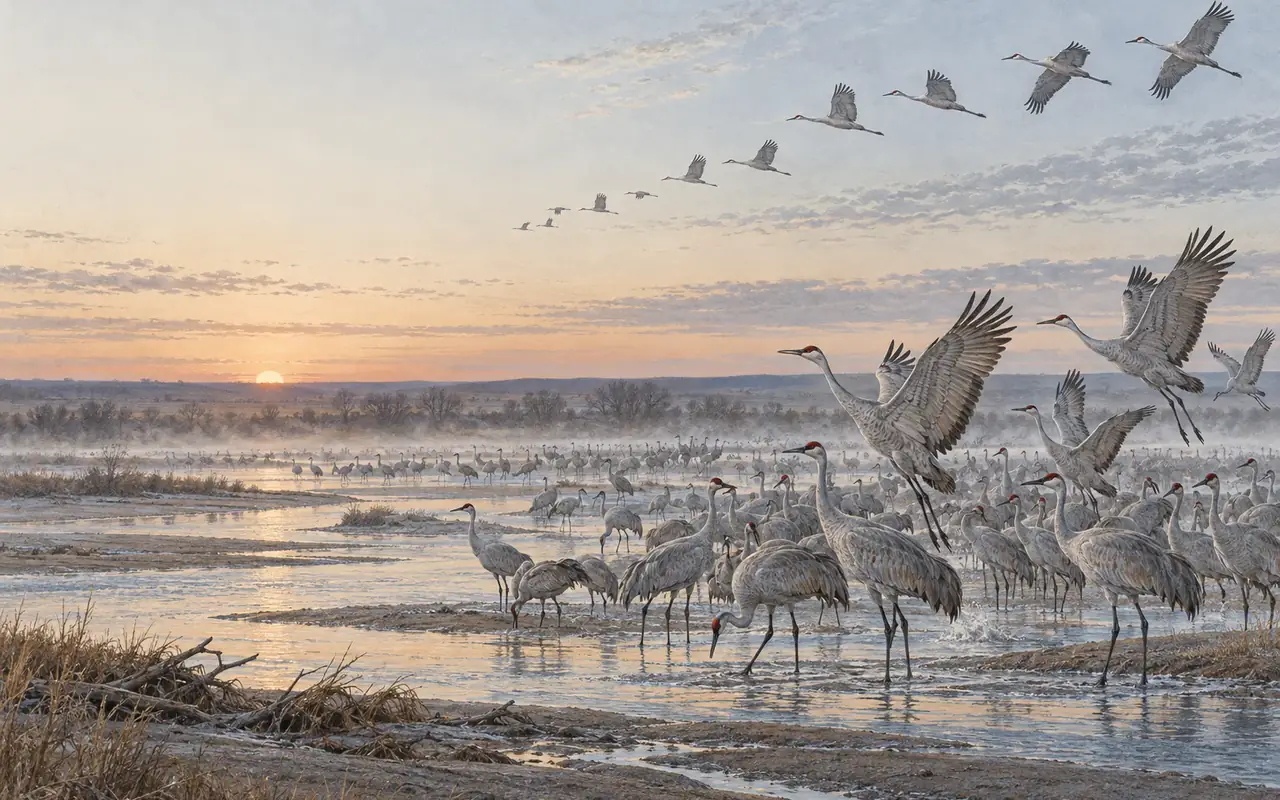
Plate I · detailAntigone canadensisDetail — the roost breaking up at sunrise
Essential 1 of 7
Spectacle
Kearney & Grand Island, Nebraska
The Platte River
Kearney & Grand Island, Nebraska
The oldest migration on the continent, twice a day.
Most of the world’s Sandhill Cranes funnel into an eighty-mile reach of the Platte to fatten on waste corn before the flight north — several hundred thousand birds in a landscape that offers them nothing else. The spectacle is the roost. At first light the river comes apart as the flocks lift off the sandbars; at dusk they pour back in, wave after wave, for the better part of an hour. Blinds at Rowe Sanctuary and the Crane Trust are reserved months ahead; the county bridges south of Kearney and Alda are free and very nearly as good.
Sandhill Crane
Snow Goose
Greater White-fronted Goose
Whooping Crane (rare)
Spectacle
The prairie-chicken leks
Eastern Colorado & the Great Plains
Booming grounds in the half-dark.
Prairie-chickens display before sunrise on traditional leks, and the last third of March is the heart of it. Wray, in Colorado’s northeast corner, runs dawn tours to Greater Prairie-Chicken grounds; the shortgrass around Campo, in the southeast, is the classic country for Lesser Prairie-Chicken. Both ask you into a blind an hour before light and then ask you to sit still, which is exactly what makes it stay with you — the birds stamp and boom a few yards away and pay you no attention at all.
April is the one month when the whole circuit lines up. Greater Sage-Grouse display in North Park near Walden, Gunnison Sage-Grouse at Waunita, Dusky Grouse along the foothill roads, White-tailed Ptarmigan still in white plumage up on Loveland Pass, and both prairie-chickens and Sharp-tailed Grouse out on the eastern plains. It is a driving trip built from consecutive pre-dawn starts and long transects between them, and it remains the most efficient week of grouse watching in North America.
Greater Sage-Grouse
Gunnison Sage-Grouse
Dusky Grouse
White-tailed Ptarmigan
Sharp-tailed Grouse
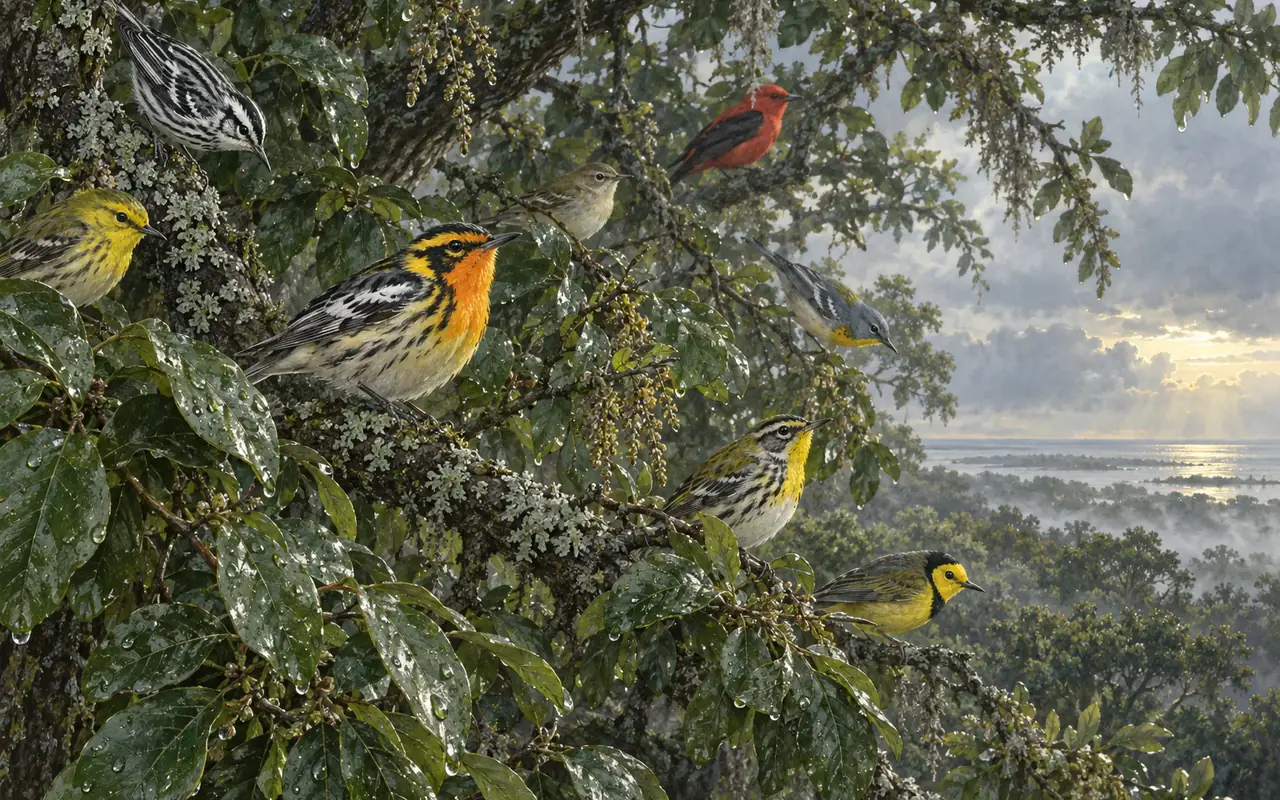
Plate IISetophaga fusca &c.Landfall after weather on the Gulf, Texas
Essential 2 of 7
Migration
Upper Texas coast
High Island & Bolivar
Upper Texas coast
When the wind turns north, the woods fill.
Migrants crossing the Gulf make landfall on the upper Texas coast, and when a north wind or a line of rain meets them over the water they drop into the first trees they can reach — the live-oak mottes at High Island. A true fallout is a matter of weather and luck, but ordinary late-April mornings still bring warblers, tanagers, grosbeaks and orioles down to eye level, with the Smith Oaks rookery of nesting Roseate Spoonbills and Neotropic Cormorants going full tilt. Bolivar Flats, ten minutes down the road, holds shorebirds in the thousands.
Cerulean Warbler
Golden-winged Warbler
Scarlet Tanager
Roseate Spoonbill
Red Knot
Migration
Dry Tortugas
Florida
Seventy miles out, a brick fort full of exhausted migrants.
Fort Jefferson is the only shade for a very long way, which makes the Dry Tortugas both a migrant trap and the one place in the country where a tropical seabird colony can be watched from dry land. Bush Key holds thousands of Sooty Terns and Brown Noddies; Masked and Brown Boobies and Magnificent Frigatebirds work the channel outside. Day trips run by ferry and seaplane from Key West, but campers get the dawn and the last hour of light, which is when the island is at its best.
Migrants moving up the Mississippi and Ohio valleys stack up against the south shore of Lake Erie, feeding in a narrow strip of beach-ridge woods until conditions favor the crossing. The Magee boardwalk concentrates them — and everyone who has come to see them — into a few hundred yards where a patient day still turns up twenty-five warbler species and puts most of them within a rod of the rail. Go early, go midweek, and give the second week of May the benefit of the doubt.
Blackburnian Warbler
Prothonotary Warbler
Bay-breasted Warbler
Connecticut Warbler
Kirtland’s Warbler (scarce)
Breeding
The Sky Island canyons
Southeastern Arizona
Trogons calling from the sycamores.
The Sky Islands come into breeding season well before the monsoon breaks, and the canyons are loud: Elegant Trogon in Madera, Cave Creek and Ramsey, Painted Redstart and Sulphur-bellied Flycatcher along the creeks, and a night shift of Whiskered Screech-Owl, Elf Owl and Mexican Whip-poor-will that makes the late hours worth keeping. Days are hot and dry, mornings are cool, and the desert lowlands below add Varied Bunting, Rufous-winged Sparrow and Lucy’s Warbler.
Elegant Trogon
Painted Redstart
Sulphur-bellied Flycatcher
Elf Owl
Whiskered Screech-Owl
Chapter Three
Summer
June – August
The continent settles onto territory, and birding becomes a matter of going to particular places: island ledges, the last native prairie, the Sky Islands under monsoon cloud. Then the first southbound shorebirds arrive in July and the year quietly turns over.
June
03moments
Breeding
The White Mountains
Northern New Hampshire
Bicknell’s Thrush singing in the fog at four thousand feet.
Bicknell’s Thrush breeds only in dense, stunted fir on northeastern summits, and the first two weeks of June — before the song tapers off — are the window. The Mount Washington Auto Road and the top of Cannon Mountain both put you in the habitat at dawn, usually inside a cloud. Lower down, Pondicherry and the spruce along the Kancamagus hold Blackpoll and Mourning Warblers, Boreal Chickadee, Black-backed Woodpecker and Spruce Grouse, so a short trip covers most of the region’s boreal list.
Bicknell’s Thrush
Blackpoll Warbler
Spruce Grouse
Boreal Chickadee
Mourning Warbler
Breeding
The seabird islands
Coastal Maine
Puffins on the ledges, terns overhead.
Restored colonies on the outer islands give the Lower 48 its only Atlantic Puffins, and midsummer is the entire season: birds ashore with fish crosswise in their bills, chicks down in the burrows, boats running daily. Eastern Egg Rock is the short trip out of New Harbor; Machias Seal Island, reached from Cutler, is the one with the blinds, where Razorbills and Common Murres stand a few feet away. Arctic, Common and Roseate Terns nest alongside, and Black Guillemots are in every harbor on the way out.
Atlantic Puffin
Razorbill
Common Murre
Arctic Tern
Roseate Tern
Breeding
The prairie potholes
North Dakota
Grassland song over a landscape of glacial ponds.
The Missouri Coteau carries the highest density of breeding ducks on the continent, and its surviving native grass holds a set of birds that are genuinely hard to find anywhere else: Baird’s Sparrow, Sprague’s Pipit skylarking out of sight, Chestnut-collared and Thick-billed Longspurs on the short grass, Nelson’s and Le Conte’s Sparrows down in the wet swales. Lostwood, Des Lacs and the country around Kenmare are the classic stops. June mornings are cool and still, and the singing carries a long way.
Wilson’s Phalaropes stage on the hypersaline lake to molt and to gorge on brine flies and brine shrimp before a nonstop flight to South America, and the last ten days of July are the peak of the gathering — hundreds of thousands of birds out on the open water, turning in tight, spinning flocks. The Antelope Island causeway and the dikes at Bear River give the access; American Avocets, Black-necked Stilts and Snowy Plovers work the shoreline in similar abundance, and Eared Grebe numbers are just beginning to build behind them.
Wilson’s Phalarope
Red-necked Phalarope
American Avocet
Snowy Plover
Eared Grebe
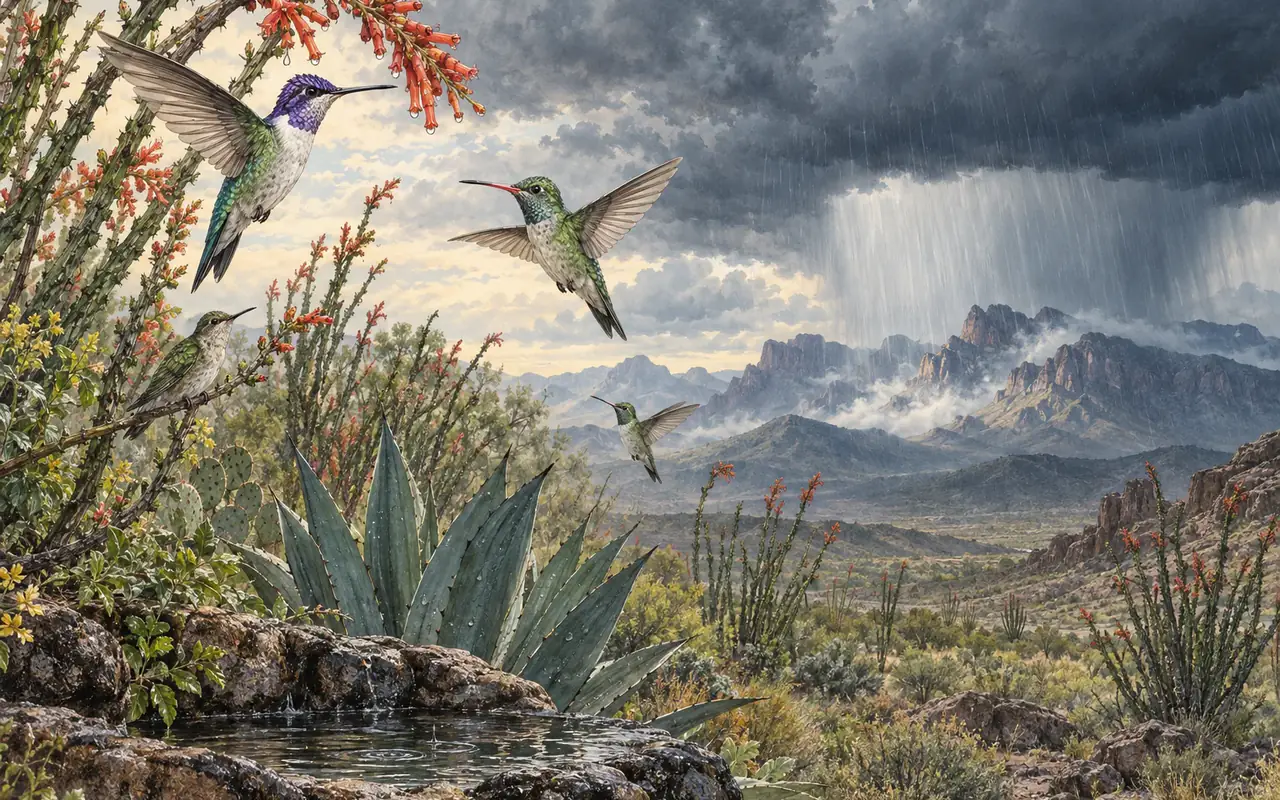
Plate IIITrochilidaeThe borderlands after the first rain, Arizona
Essential 5 of 7
Breeding
Southeastern Arizona
The monsoon borderlands
Southeastern Arizona
A second spring, and the hummingbird feeders at capacity.
The summer rains green the grasslands, trigger a second round of breeding, and pull hummingbirds north out of Mexico. A patient afternoon in the Huachucas or at the Paton Center can produce a dozen species or more, Violet-crowned, White-eared, Berylline and Lucifer among them. Botteri’s and Cassin’s Sparrows are in full song; Buff-collared Nightjar and Thick-billed Kingbird are on territory; and the storms build over the ranges every afternoon with something close to punctuality.
A submarine canyon that brings the open ocean close to shore.
The Monterey Canyon reaches almost to the beach, so a day boat is over deep water within an hour and spends the rest of the trip among shearwaters. Late summer is the richest stretch of the year: Black-footed Albatross, Pink-footed, Buller’s, Sooty and occasionally Flesh-footed Shearwaters, all three jaegers, South Polar Skua, Ashy and Black Storm-Petrels rafting along the canyon rim, and Sabine’s Gulls moving through. A warm-water year adds Craveri’s Murrelet and the odd stray tubenose from the tropics.
Black-footed Albatross
Buller’s Shearwater
Ashy Storm-Petrel
South Polar Skua
Sabine’s Gull
Chapter Four
Autumn
September – November
Fall is longer, heavier and less forgiving than spring — more birds, duller plumage, better weather, and a hard dependence on the wind. Almost everything here is decided by the front that came through the night before.
Broad-wings streaming past Duluth in the thousands.
Raptors moving south down the western shore of Lake Superior will not cross the open water, so they are funneled along the ridge above Duluth, where a count has run every autumn for half a century. Mid-September belongs to Broad-winged Hawks: on the right day — light northwest winds on the back of a front — kettles stack up over the ridge and the tally climbs into the tens of thousands. Sharp-shinned Hawks are constant background, and the dawn passerine flight below the overlook rewards an early arrival.
Broad-winged Hawk
Sharp-shinned Hawk
American Kestrel
Merlin
Bald Eagle
Spectacle
Hazel Bazemore
Corpus Christi, Texas
The whole eastern population, over one hill.
Very nearly every Broad-winged Hawk in eastern North America passes through South Texas on its way to the tropics, and the count above the Nueces River at Hazel Bazemore County Park regularly totals several hundred thousand birds in a season. Late September concentrates it: on a peak day the sky carries streams and kettles from one horizon to the other for hours at a stretch. Mississippi Kites move early in the window, Swainson’s Hawks at the end of it.
Broad-winged Hawk
Swainson’s Hawk
Mississippi Kite
Anhinga
Wood Stork
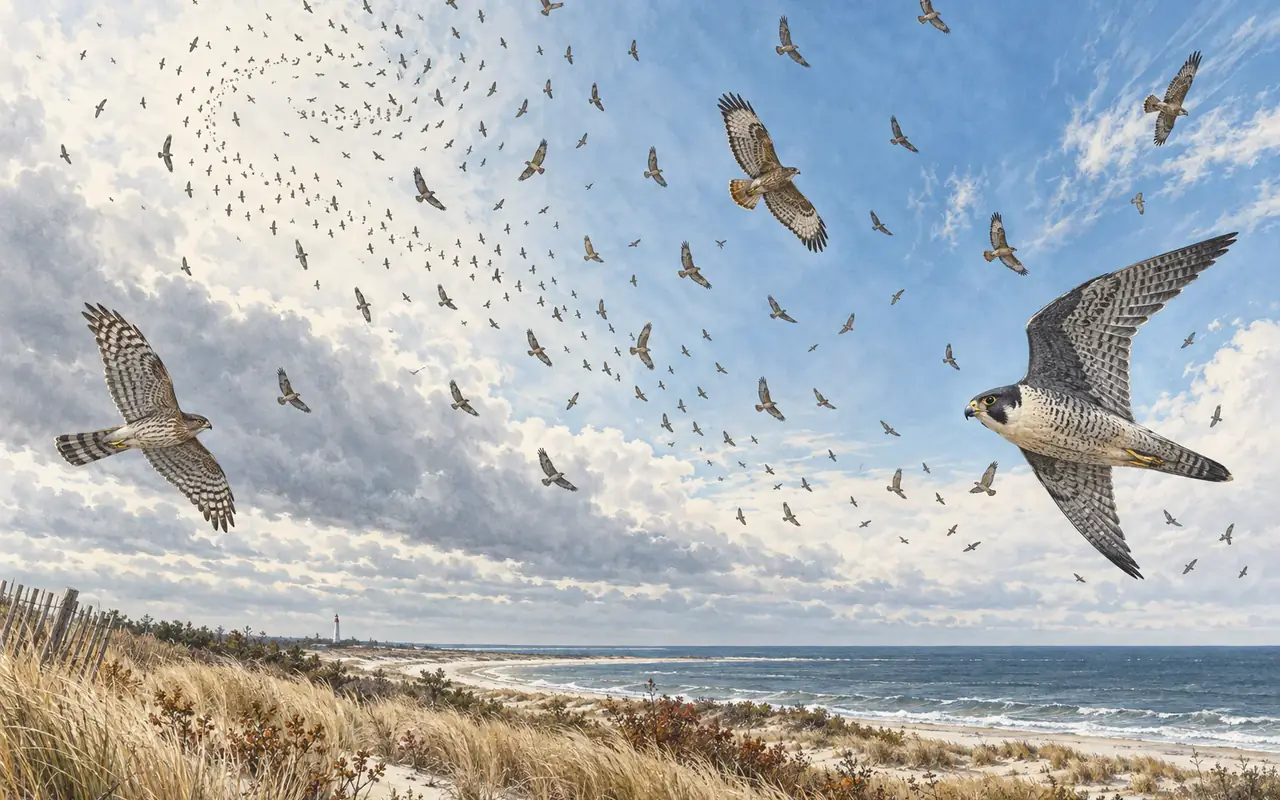
Plate IVFalco peregrinus &c.A northwest wind over the point, New Jersey
Essential 6 of 7
Migration
New Jersey
Cape May
New Jersey
A peninsula that gathers everything and holds it until the wind changes.
Migrants working down the New Jersey coast pile up at the end of the peninsula, reluctant to start across Delaware Bay, and a northwest wind behind a cold front sets the entire place in motion. The first half of October is the best of it: falcons along the dunes, a morning flight over the Higbee dike that can run to thousands of birds an hour, flickers and Blue Jays pouring south in loose companies, and monarchs going with them. The hawk watch platform at Cape May Point serves as the town’s living room.
The late flight: sparrows, seabirds, and the season’s mistakes.
The back half of October trades warbler variety for weight and for possibility. Yellow-rumped Warblers and kinglets fill the thickets, sparrows work every field edge, scoters and Northern Gannets stream past the Avalon seawatch, and the rarity odds tilt hard — late October is when western strays and the first Cave Swallows turn up. Fewer people on the platform, colder mornings, better light.
Northern raptors move at the end of the season, and by late October the Duluth count has shifted from streams of Broad-wings to singles worth standing in the cold for: Golden Eagles riding the ridge lift, Rough-legged Hawks, American Goshawks in an irruption year, and Bald Eagles in real numbers. Northern Shrikes arrive alongside them, winter finches go over calling, and the first Snowy Owls appear down on the harbor ice.
Parrots to roost, and the first strays across the river.
November is when the Valley resets. Wintering sparrows and raptors arrive, the resident specialties become easy again, and the season’s first Mexican vagrants begin turning up in the refuges — Crimson-collared Grosbeak, Blue Bunting, Golden-crowned Warbler and Tropical Parula among the regulars. At dusk, Red-crowned Parrots pour into roosts in Brownsville, Harlingen and Weslaco: several hundred birds shouting at once over a residential street.
The circle closes. Cranes and geese settle onto their wintering grounds, the bog fills with owls, and the first page of the calendar is open again.
November
01moments
Essential 7 of 7
Spectacle
New Mexico
Bosque del Apache
New Mexico
Blast-off at sunrise over a frozen pond.
The Rio Grande bottomland at Bosque holds wintering Sandhill Cranes in the thousands and Snow and Ross’s Geese in the tens of thousands, and the refuge is arranged for watching them — a loop road along flooded fields, and roost ponds within sight of the parking area. The geese leave all at once at first light, the blast-off that people drive across three states for; the cranes come back in family groups at dusk against the Chupadera Mountains. Late November brings the festival and the crowds. December is colder and much quieter.
The Aransas–Wood Buffalo population is the last naturally occurring flock of Whooping Cranes in the world, and it winters on the salt marsh of the central Texas coast, family groups holding the same pans year after year. Boat tours out of Rockport and Fulton get close enough to watch a pair work a blue crab apart; the observation tower at the refuge does the job on a calm morning. Reddish Egrets, Long-billed Curlews and wintering sparrows fill in everything around them.
Whooping Crane
Reddish Egret
Long-billed Curlew
Sandhill Crane
Roseate Spoonbill
Specialties
Sax-Zim Bog
Minnesota
The year closes where it will begin again.
December opens the bog’s winter season. Feeders go up, the first Great Gray and Northern Hawk Owls are found along the county roads, and the shape of the winter’s finch irruption becomes clear — whether this is a Pine Grosbeak year, a redpoll year, or neither. It is quieter than February and the birds are less predictable, which is a fair part of the appeal. Most of what is here in December will still be here in six weeks, when the calendar starts over.