Birding window
Cape May
Three weeks at the end of the funnel
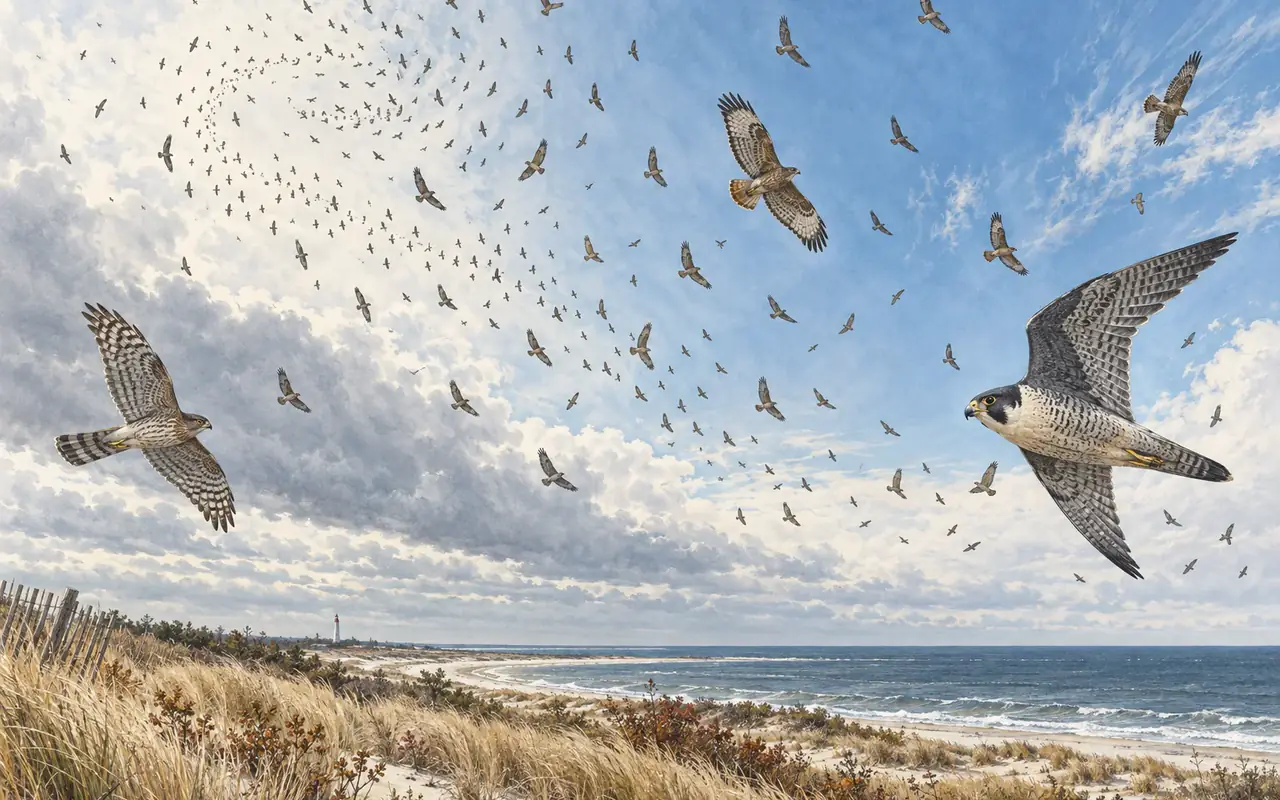
Everything moving down the New Jersey coast arrives at the same dead end. What you see depends almost entirely on what the wind did last night.
Cape May is a peninsula that narrows to a point with Delaware Bay on one side and the Atlantic on the other, and migrants working south down the coast concentrate along it and then balk at the crossing. Between the last week of September and the middle of October the concentration is at its heaviest and its most varied: falcons along the dunes, a morning flight of songbirds over the Higbee dike, shorebirds on the tide, and seabirds beginning to move past Avalon. This is a plan for three days, built to be reordered every evening when the forecast comes in.
At a glance
Planning the trip
- Give it
- Three days, and be willing to spend them in any order. A single day here is a lottery ticket on the weather; three gives you a real chance of catching the morning after a front, which is the difference between a good trip and the one people talk about for years.
- Base in
- Cape May itself, or Cape May Point. Everything on the point — Higbee, the hawk watch, the Meadows, the Beanery — is within about ten minutes of the town, which matters when you are deciding where to be at 6.30 a.m. Stone Harbor and Avalon are twenty to thirty minutes north.
- Fly into
- Philadelphia (PHL) is the practical airport — about 68 miles and an hour and three-quarters, with real flight choice. Atlantic City (ACY) is much closer at roughly 48 miles and forty-five minutes, but has a thin schedule. Both need a car.
- Car
- Yes, though less than anywhere else in this calendar. The point sites are close enough to cycle between, and in practice you will walk a lot. You need the car for Avalon, Stone Harbor Point and Nummy Island, and for the speed to change plan at dawn.
- Difficulty
- Easy. Flat, short, paved or sand walking throughout, with the hawk watch platform and much of the Meadows accessible. The demanding part is identification: morning flight is birds going away from you, overhead, fast, in silhouette, and nobody is good at it on their first morning.
- Book ahead
- Lodging, and early. Cape May is a resort town whose autumn is busy anyway, and New Jersey Audubon's Cape May Fall Festival lands at the very end of this window — 15 to 18 October in 2026 — filling rooms across the whole point. Nothing else here needs reserving except a Beanery pass.
Natural history
Why this window
Migrating landbirds moving south down the New Jersey coast are funnelled by the shape of the state itself, and the funnel ends at Cape May Point, where Delaware Bay opens up twelve miles wide to the west. Most small migrants and most raptors are reluctant to start a long water crossing, particularly into a headwind, so they turn back inland, drift down the peninsula again, and accumulate. Nothing about this is subtle: the birds are concentrated because they have run out of land.
The migration that arrives is not one migration but several, running on different schedules and different weather. Songbirds move at night and come down before dawn, producing the phenomenon Cape May is most famous for — the morning flight, a reorientation flight of birds streaming back north over the Higbee dike just after sunrise, which on the best days has exceeded a hundred thousand birds. Raptors move by day once thermals develop, and the count at Cape May Point State Park has been staffed every autumn since 1976. Shorebirds work the tide on the back bays. Seabirds begin moving past Avalon in the first days of October.
The last week of September through mid-October is when these overlap most completely. It is the peak period for raptor diversity and for Peregrine Falcons, the heaviest stretch of the morning flight, and the start of the Avalon Seawatch. It is also when the weather is most likely to cooperate: this is cold front season, and a front is the engine that drives everything here.
The plan
Three days, in any order
These are not day one, two and three so much as three modes. Look at the forecast each evening and run whichever one tomorrow calls for. If you get two fronts in three days, run the first day twice and drop the third — nobody who has seen a real Cape May morning regrets repeating it.
The morning after a front
North-west wind, falling temperature
The day you came for, and the one to drop everything else for. A cold front has gone through overnight and the wind has swung into the north-west. Be at Higbee before sunrise.
-
Sunrise −20 minDawn
The Higbee dike, for the morning flight
Higbee Beach Wildlife Management Area, free, with a small gravel lot that fills early — get there in the dark. Songbirds that flew all night come down on the bayshore and then reorient, streaming back north over the dike in the first two hours of light. On a good morning this is thousands of birds an hour; on a great one it is beyond counting. Note the seasonal rule: from 15 September until 1 November, use of the WMA is restricted to the marked trails, and the WMA itself is closed from 9 p.m. to 5 a.m. Stand with the counter, listen more than you look, and accept that most of them will go unidentified.
-
09:00Break
Breakfast, and let the air warm
The flight fades as the sun gets up and raptors do not really move until thermals form. This hour is free. Use it.
-
10:00Daylight
The hawk watch platform
Cape May Point State Park is free to enter, with a parking lot and the platform immediately east of it; check the posted gate hours. The official count has run here every autumn since 1976, sunrise to sunset, 1 September to 30 November. Late September to mid-October is peak accipiter and falcon time — Sharp-shinned Hawks in numbers, Merlins low and fast over the dunes, and Peregrines at their best of the year. A few hundred birds is a normal day; a few thousand is a front day. The platform is also the town's noticeboard: whatever is being seen, someone on it knows.
-
14:00Daylight
The Meadows, on foot
The Nature Conservancy's South Cape May Meadows is a couple of minutes away — free, about two miles of flat trail through freshwater wetland and dune, with observation platforms and a lot of about thirty spaces off Sunset Boulevard. No dogs, no bikes. Herons, waterfowl, harriers quartering the grass, and whatever songbirds came down that morning working the hedgerows. It is also the best place to watch falcons hunting.
-
SunsetDusk
Back to the point
Raptors keep moving until the light goes, and the last hour on the platform or at the Point is often the quietest and the best. Monarchs roost in the cedars in this window too, sometimes in hundreds.
Wind off the sea
Southerly or easterly, or the front has passed
The morning flight will be poor and the hawk watch slow, which is exactly when the coast pays. Counter-intuitively, the seawatch prefers the winds that shut the songbirds down.
-
SunriseDawn
Avalon Seawatch
Thirty minutes north, on the beach between 8th and 9th Streets, where the coastline juts about a mile further east than anything around it and passing seabirds are pushed close in. Free, counted daily sunrise to sunset from 1 October to 22 December. Southerly and easterly winds produce better flights here than northerly or westerly ones, and movement is heaviest early and late in the day. Early October is the beginning rather than the peak — scoters, loons, cormorants and the first gannets — but on the right wind it is the best birding of the day.
-
Mid-morningDaylight
Shorebirds, on the tide and not the clock
Work Nummy Island and Stone Harbor Point on the falling or rising tide — roughly two hours either side of low is the usual advice, and at high water the birds are pushed off the flats entirely. Nummy Island is roadside viewing from Ocean Drive across the salt marsh: park well off the pavement. Stone Harbor Point is a walk out along the beach. Late September into October is when Nelson's Sparrows arrive in the marsh, which is a different and much more patient kind of birding.
-
13:00Break
Lunch, and check the platform's news
Back to the point. Even on a slow day, look in at the hawk watch: the counter will know whether anything has been found, and an hour there costs nothing.
-
15:00Daylight
The Beanery, slowly
Rea Farm — the Beanery — is private working farmland on Bayshore Road that New Jersey Audubon members may bird by permit; non-members can buy a day pass or come on a CMBO walk. Hedgerows, field edges and a pond, and it holds grounded migrants when the point itself is bare. Walk the crop margins and nothing else; the arrangement exists because the family allows it.
Soft weather
Warm, still, or wind in the south-west
The hardest day to plan and the one most visitors waste. Nothing new has arrived overnight, the sky is empty, and the answer is to stop looking up.
-
SunriseDawn
Cox Hall Creek WMA, for grounded birds
A quiet free WMA of old golf course, woodland and ponds north of the canal, and the kind of place that holds birds when the point is empty. Slow, close-range birding — thrushes, vireos, whatever warblers stayed — rather than spectacle. Go early anyway; songbirds feed hardest in the first two hours whatever the wind is doing.
-
Mid-morningDaylight
The Meadows and the point, on foot
Walk rather than drive. On a still day the Meadows holds waterfowl, waders and rails at the margins, and the state park trails and Bunker Pond give you ducks and shorebirds at close range. This is also the best day of your trip for photography: no wind, soft light, and birds that are staying put.
-
Tide-dependentDaylight
Shorebirds again, if the tide is right
Soft weather does not affect the tide. If low water falls in the afternoon, go north to Stone Harbor Point; if not, the Meadows and the state park ponds will hold something.
-
SunsetDusk
The platform, for the forecast
End on the hawk watch whatever the day was like, and find out what tomorrow is supposed to do. The whole point of a three-day trip here is being ready to change plan, and the platform is where that information lives.
Ground
Where to bird
Five sites on the point, within ten minutes of each other, and two up the coast that are worth the drive on the right wind or tide.
-
01
Higbee Beach WMA
New England Rd, Lower Township · the dike
Free · marked trails only The morning flight, in the first two hours of light
Eleven hundred acres of dune, scrub, woodland and old fields on the bayshore, and the site of CMBO's Morning Flight count, run 1 August to 15 November since 2003. From 15 September to 1 November use is restricted to the marked trails, and the WMA is closed 9 p.m. to 5 a.m. The gravel lot is small and fills before dawn on front mornings. No water, no toilets.
-
02
Cape May Point State Park
Lighthouse Ave, Cape May Point · hawk watch
Free · check gate hours The raptor count, and the town's information exchange
Free entry and free parking, with the hawk watch platform just east of the lot and an official counter on duty sunrise to sunset from 1 September to 30 November. Trails, ponds and dune crossings behind it hold ducks, shorebirds and grounded migrants. There is a fee only to climb the lighthouse.
-
03
South Cape May Meadows
Sunset Blvd, Cape May · Nature Conservancy
Free · no dogs or bikes Waterbirds, harriers, and hunting falcons
Two hundred acres of restored freshwater wetland, dune and beach with about two miles of flat trail, observation platforms and a floating blind. Free, donations encouraged, with a gravel lot of roughly thirty spaces. Pets, bicycles and vehicles are not permitted. Accessible to most visitors and productive in almost any weather.
-
04
Rea Farm — the Beanery
Bayshore Rd, West Cape May · private
Member or day pass Grounded migrants when the point is bare
Private working farmland birded by arrangement with New Jersey Audubon: free to NJA and CMBO members with a current permit, a day pass for everyone else, or come on a scheduled CMBO walk. Hedgerows, field margins and a pond. The family asks that visitors keep to the perimeter of the crops, which is the whole basis of the access.
-
05
Cox Hall Creek WMA
Shawcrest Rd, Villas · north of the canal
Free The quiet alternative on a dead morning
A former golf course returned to woodland, scrub and ponds, free and rarely crowded. It holds grounded songbirds on days when the point has nothing, and it is the right answer to soft weather. Same WMA rules apply, including the 9 p.m. to 5 a.m. closure.
-
06
Nummy Island & Stone Harbor Point
Ocean Drive and 2nd Ave, Stone Harbor
Free · tide-dependent Shorebirds and salt-marsh sparrows, on the tide
Nummy Island is roadside viewing over open salt marsh from Ocean Drive — park well clear of the pavement, there are no designated pull-offs. Stone Harbor Point is a beach walk from the 2nd Avenue lot out to flats and dunes. Both are governed by the tide rather than the clock; roughly two hours either side of low is the working window. Nelson's Sparrows arrive in the marsh from late September.
-
07
Avalon Seawatch
Beach between 8th and 9th St, Avalon
Free · counted from 1 Oct Seabirds, on a southerly or easterly wind
The coast here projects about a mile further east than the shoreline either side, pushing passing seabirds close inshore. Counted daily sunrise to sunset from 1 October to 22 December, and running since 1993. Southerly and easterly winds produce the better flights, and movement is heaviest early and late. Bring a scope and something to sit on.
The list
What to look for
Cape May is not a guaranteed fallout and it is worth saying so plainly: a warm, still week in the first half of October can be very quiet. What the peninsula reliably concentrates is raptors and, given the right night, an enormous but largely unidentifiable morning flight. The third group here is the reason people stay a week, not a reason to come.
What the window is built on
- Peregrine Falcon Falco peregrinus
- This is their best three weeks anywhere on the continent. Low along the dunes, or high and purposeful over the platform.
- Merlin Falco columbarius
- Fast, dark and bad-tempered, hunting dragonflies over the Meadows and harassing everything else.
- American Kestrel Falco sparverius
- The most numerous falcon on the count in this window, often in loose morning movements.
- Sharp-shinned Hawk Accipiter striatus
- The bulk of a front-day count. Mid-September to mid-October is the accipiter peak.
- Northern Flicker Colaptes auratus
- One of the signatures of a Cape May October — loose companies going south all morning, low over the dunes.
- Blue Jay Cyanocitta cristata
- Strings of them along the bayshore, turning back at the point rather than crossing. Easy to dismiss and worth watching.
Likely, given the right morning or tide
- American Redstart Setophaga ruticilla
- Among the commonest warblers in the morning flight in late September, and one of the few identifiable overhead.
- Blackpoll Warbler Setophaga striata
- Peaks as September turns to October, staging before a long oceanic crossing.
- Bobolink Dolichonyx oryzivorus
- Heard before seen — a distinctive flight note over the fields at Higbee and the Beanery.
- Northern Harrier Circus hudsonius
- Quartering the Meadows and the dune grass at any hour, often at very close range.
- Osprey Pandion haliaetus
- Peak passage mid-September to mid-October, and still fishing the back bays.
- Black-bellied Plover Pluvialis squatarola
- The default large shorebird on the flats at Stone Harbor Point on a falling tide.
- Nelson’s Sparrow Ammospiza nelsoni
- Arrives in the salt marsh from late September. Nummy Island on a high tide, and a lot of patience.
The ones people stay for
- Connecticut Warbler Oporornis agilis
- Annual and genuinely difficult — a skulker in damp field edges, most likely late September. Most records are of a bird flushed once.
- Western Kingbird Tyrannus verticalis
- A near-annual October stray, usually on wires or fence lines around the farm fields.
- Lark Sparrow Chondestes grammacus
- Scarce but regular in autumn, on open ground and dune edges.
- Clay-colored Sparrow Spizella pallida
- Turns up most years in the same weedy margins as the commoner sparrows. Check every Chipping Sparrow.
- American Golden-Plover Pluvialis dominica
- A few each autumn on short grass and the back-bay flats, among the Black-bellied Plovers.
Practical
Know before you go
Reading the weather
This is the whole skill. A cold front passing overnight, followed by north to north-west winds and falling temperatures, is what puts birds on the peninsula and into the air — it both stimulates migration and pushes birds toward the coast. Plan the next morning around the front, not the date. North-east winds can also produce strong falcon flights. Winds from the south or south-west mean birds carry on past or never left, and the morning flight will be thin. Check the National Weather Service forecast for Cape May the evening before, look at where the front is, and pick tomorrow's day accordingly.
The wind cuts both ways
The winds that shut down the morning flight are the ones the Avalon Seawatch prefers: southerly and easterly conditions produce better seabird movement there than northerly or westerly. This is the single most useful piece of local knowledge on this page, because it means there is no wind direction on which the whole region is dead — only directions on which you are standing in the wrong place.
Crowds and parking
Cape May in autumn is a working resort town as well as a birding destination, and the Fall Festival — 15 to 18 October in 2026 — coincides with the end of this window and fills accommodation across the point. The practical crowding is at car parks, not at the birds: Higbee's gravel lot is small and gone before sunrise on a front morning, and the Meadows has about thirty spaces. Arrive early or walk. The hawk watch platform gets busy and that is a feature, not a problem.
Access and rules
Higbee Beach and Cox Hall Creek are state Wildlife Management Areas: free, closed 9 p.m. to 5 a.m., and Higbee is restricted to marked trails from 15 September to 1 November. The Meadows bans dogs and bicycles. The Beanery is private land accessed by New Jersey Audubon permit or day pass, and that access depends on visitors keeping to the field margins. Stone Harbor Point and other beaches may carry seasonal wildlife closures — respect the posted fencing even outside the nesting season.
Insects and ticks
Salt-marsh mosquitoes are still active into October, particularly at dawn and dusk and after rain, and Higbee and the Beanery can both be unpleasant on a still morning. Greenhead flies have mostly finished by late September. Ticks are a year-round concern in the scrub and long grass here, and autumn is peak season for nymphal and adult deer ticks: long trousers, repellent, and check yourself in the evening.
Photography
Morning flight is the hardest photography in this calendar — small birds, fast, overhead, backlit, in poor light. Do not plan on it. The productive photography here is raptors at the platform and over the Meadows in afternoon light, hunting falcons and harriers at close range, and the shorebirds at Stone Harbor Point on a falling tide. Soft, windless days are bad for flight and good for pictures, which is a useful trade.
If it goes wrong
The failure mode is a run of warm southerly days with no front. Do not spend them staring at an empty sky. Bird the ground instead: Cox Hall Creek, the Beanery margins and the Meadows all hold grounded migrants that a front-chasing visitor never looks for. Work the tide at Stone Harbor Point, which does not care about the wind. And use the hawk watch platform as intelligence — the counter and the regulars will know whether anything has been found and when the next front is due.
Sources
Count dates, festival dates and seasonal access rules change from year to year. Confirm against the official pages before you travel.
- New Jersey Audubon — Cape May Hawkwatch
- New Jersey Audubon — Morning Flight
- New Jersey Audubon — Avalon Seawatch
- New Jersey Audubon — Rea Farm (the Beanery) access
- NJDEP Fish & Wildlife — Higbee Beach WMA
- NJDEP — Cape May Point State Park
- The Nature Conservancy — South Cape May Meadows
- NOAA National Weather Service — Mount Holly / Cape May forecast
Last reviewed 21 September 2026