Birding window
The Platte River
Two dawns on the braided river
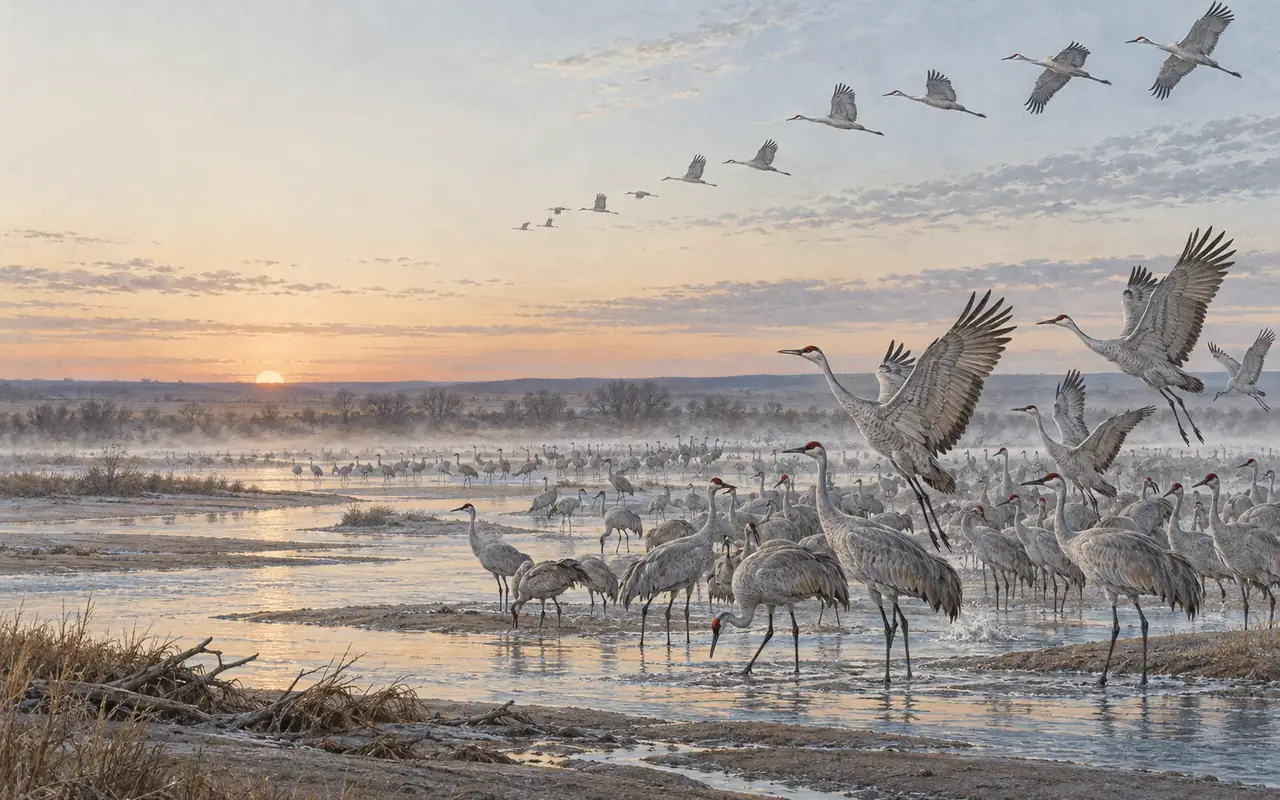
For six weeks the Platte holds more Sandhill Cranes than anywhere on earth. The birds are the easy part. Getting the shape of the day right is what separates a good trip from a great one.
An eighty-mile reach of shallow, braided river between Overton and Chapman, Nebraska, is the narrow waist of an hourglass: more than eighty per cent of the world’s Sandhill Cranes pass through it every spring, and most of them are standing in it at dawn. This is a plan for two days, built around the two hours that matter.
At a glance
Planning the trip
- Give it
- Two nights, three days. One dawn is a rumour; two is a memory. Arrive by mid-afternoon on day one so you do not miss that evening’s fly-in.
- Base in
- Kearney or Grand Island. Both sit on I-80 within the crane reach and are about forty-five minutes apart. Kearney is closer to Rowe Sanctuary and Fort Kearny; Grand Island is closer to the Crane Trust and Alda. Either works — do not split the two nights.
- Fly into
- Grand Island (GRI) has American service to Dallas–Fort Worth and Allegiant service to Las Vegas and Phoenix. Kearney (EAR) has daily United Express flights to Denver. Omaha (OMA) has far more choice and is about 2 h 20 from Grand Island, 2 h 45 from Kearney; Lincoln (LNK) is on the same road, nearer.
- Car
- Essential. The viewing sites are strung along forty miles of county road and interstate exits, the good hours are before dawn and after dusk, and there is no transit. Your car is also your blind for daytime field-watching.
- Difficulty
- Easy walking — the longest approach is about a third of a mile of flat, paved trail. The difficulty is cold and hours: dark starts, an unheated blind, and three hours of sitting still.
- Book ahead
- Blind tours sell out. Rowe Sanctuary opens 2027 reservations on 7 January at 9 a.m. CST; the Crane Trust gives members priority from 5 October 2026 and opens to the public in November. Book lodging at the same time you book the blind.
Natural history
Why this window
The Platte is a staging ground, not a destination. Cranes arriving from Texas, New Mexico and northern Mexico stop here to put on fat — as much as twenty per cent of body weight — before a flight that ends on the tundra. They need two things the central Platte still has together in one place: waste corn in the surrounding fields, and a wide, shallow, sandbar-braided channel to roost in at night, where the water is ankle-deep and a coyote cannot approach unheard.
So the spectacle is not the feeding. It is the commute. Every evening the birds pour back onto the river in waves for the better part of an hour, and every morning the river comes apart at first light as they lift off in sheets. Between those two hours the cranes are scattered across cornfields for miles and the river is empty. Plan the day around the ends of it.
The Crane Trust flies a weekly aerial survey of the eighty-five-mile reach from Chapman to Overton. Their record count is 736,000 birds, in the fifth week of the 2025 migration; in 2026 they estimated 494,000 on 12 March. Numbers on that scale are less useful than the shape of the curve, which is broad: the first birds arrive around Valentine’s Day and the last leave around Tax Day.
The plan
Two days
This is the centre of the trip and the part most people get wrong, by trying to fill the middle of the day. The cranes keep banker’s hours in reverse. Build the day around dawn and dusk, and treat the eight hours between them as recovery.
Day one
Arrive, and go straight to the river
Travel day. Everything here is free and needs no reservation — save the booked blind for a morning when you are rested.
-
By 15:00Travel
Get to your base
Check in at Kearney or Grand Island and stay checked in. If you are flying into Omaha, leave by late morning. Buy a Nebraska park entry permit now if you plan to use Fort Kearny — they are sold at the Fort Kearny visitor centre and the recreation-area kiosk, and you do not want to be hunting for one in the dark.
-
15:30Daylight
Find the birds in the fields
Drive Platte River Drive east and south of the Alda interchange, or Elm Island Road west of Rowe Sanctuary. Cranes spend the day loafing and feeding in stubble, often within a hundred yards of the road, and this is when you actually watch behaviour: the bowing, the tossed cornstalks, the leaping. Stay in the car — it is a better blind than you are — and use the marked turnouts. Never stop on the roadway, in a driveway or on a farm track.
-
17:00Break
Coffee and layers
Go back into town, eat something early, and put on more clothes than you think you need. You will be standing still outdoors in the dark at the coldest hour of the evening. March in Kearney averages a high near 53°F and a low near 33°F, and the wind comes off open ground.
-
Sunset −60 minDusk
The fly-in, from a free site
Two good unbooked options. The Fort Kearny State Recreation Area hike–bike bridge is an old railroad crossing over both channels, about a third of a mile of flat paved trail from the lot, and puts you directly over the water — as many as 20,000 birds roost within sight of it. The Richard Plautz Crane Viewing Site, 1.5 miles south of I-80 exit 285 at Gibbon, has two elevated decks, free parking and no permit. Arrive an hour before sunset, stay forty minutes past it, and do not leave when the light goes: the last and largest waves come in when you can barely see.
-
20:00Night
Sleep early
Tomorrow starts in the dark. Set out tomorrow’s clothes tonight.
Day two
The blind at dawn, then get out of the middle of the day
The booked morning. Confirm your meeting time and place when you reserve — it is earlier than you expect.
-
Pre-dawnDawn
Into the blind
A guided blind tour is the one thing worth paying for: it puts you on the riverbank before light, behind a screen, close enough to hear the birds breathing. Rowe Sanctuary runs roughly three-hour sunrise and sunset tours at $60 a person, ages ten and up, from its centre at 44450 Elm Island Road, Gibbon. The Crane Trust runs morning and evening blind tours at $65, ages twelve and up, from 9325 S. Alda Road, Wood River. Both ask for dark, layered clothing — long underwear, insulated hat, warm gloves, non-cotton socks — and both prohibit flash. Standard Rowe tours also bar tripods and continuous shooting; book the dedicated photography tour if you need either.
-
09:00Break
Breakfast, and then actually rest
You have been awake since five and you have another cold evening ahead. Eat properly and go back to the room for an hour. This is the single most common planning mistake: people fill the middle of the day, arrive at dusk exhausted, and leave early on the best night of the trip.
-
11:00Daylight
Visitor centre, then a slow driving loop
Rowe’s Iain Nicolson Audubon Center is free to enter and open 10–5 Tuesday to Saturday during crane season; the Crane Trust Nature & Visitor Center is the other hub and runs a 10 a.m. daytime driving tour by fourteen-seat bus ($45, ages six and up) if you would rather be driven. On your own, work the county roads between the Gibbon and Alda interchanges with the windows down — finding cranes by ear is genuinely the fastest method — and scan the flooded stubble for Snow and Greater White-fronted Geese and the fence posts for Bald Eagles.
-
14:00Break
Off your feet
Deliberately empty. Read, nap, sort photographs, buy warmer gloves.
-
Sunset −75 minDusk
The second evening, from a different vantage
Change the angle rather than repeating it. If last night was a bridge, take the river-level view: the Crane Trust’s evening footbridge tour is $15, ages twelve and up, and leaves the visitor centre at 6 p.m., or book an evening blind. If last night was a blind, go wide instead — the Alda Crane Viewing Deck, two miles south of I-80 exit 305, is free, fully accessible and gives you the sky as well as the water. Get there early. The hour before the birds arrive, with the light going and the first calls carrying in from the fields, is the part people remember.
Ground
Where to bird
The whole thing happens in a forty-mile strip between the Kearney and Grand Island interchanges. Five places cover it.
-
01
Fort Kearny SRA hike–bike bridge
1020 V Road, Kearney · I-80 exit 272
No booking Over-river roost viewing, free of charge
An old Burlington & Missouri River railroad crossing, now paved trail, spanning both channels about a third of a mile from the parking lot. The best over-river view you can get without a reservation, with up to 20,000 birds roosting in sight. A Nebraska state park entry permit is required; buy it at the Fort Kearny visitor centre or the kiosk. Get there half an hour before sunrise or sunset.
-
02
Iain Nicolson Audubon Center at Rowe Sanctuary
44450 Elm Island Road, Gibbon · I-80 exit 285
Book ahead The classic guided blind, and an indoor fallback
Audubon’s centre is four miles off the interstate and about twenty minutes from Kearney. Admission to the building and the trails is free; the blinds are not. Three-hour sunrise and sunset tours run 3 March – 6 April 2027 at $60 per person, with dedicated photography tours and sixteen-hour overnight blinds from 11 March. Trails may close at staff discretion when cranes are on the river — wildlife comes first, and that policy is the reason the birds still use the reach.
-
03
Richard Plautz Crane Viewing Site
1.5 miles south of I-80 exit 285, Gibbon
No booking Free elevated decks, no permit, no booking
Two raised wooden decks with a wide concrete trail and a free lot, run by the Central Platte Natural Resources District. Open year-round, free, and the easiest good evening in the valley if you arrive without a reservation.
-
04
Crane Trust Nature & Visitor Center
9325 S. Alda Road, Wood River · I-80 exit 305
Book ahead Blinds, a footbridge, and a daytime bus tour
The eastern hub, and the organisation that flies the weekly count. Riverfront blind tours are $65 (ages 12+); a 10 a.m. daytime driving tour by fourteen-seat bus is $45 (ages 6+); a 6 p.m. footbridge tour over the north channel is $15 (ages 12+) and is the cheapest guided time you can buy on the water. Members book from 5 October 2026; the public from November.
-
05
Alda Crane Viewing Deck
2 miles south of I-80 exit 305, Alda
No booking Free, fully accessible, wide sky
A rebuilt platform on a paved recreational trail with two lots and full ADA access — the best free option for anyone who cannot manage the walk to the Fort Kearny bridge. Roadside turnouts on Platte River Drive, south and east of the Alda interchange, cover the daytime field-watching nearby.
The list
What to look for
This is not a big-list destination. It is one overwhelming bird, a supporting cast of waterfowl and raptors, and two or three things worth hoping for.
The reason you came
- Sandhill Crane Antigone canadensis
- More than eighty per cent of the world population moves through this reach. Watch for the size difference between the Lesser and Greater subspecies in the same flock, and listen at the roost — the sound carries further than the birds are visible.
Almost certain
- Snow Goose Anser caerulescens
- In the flooded stubble, often in blizzards of their own. Check for blue morphs.
- Greater White-fronted Goose Anser albifrons
- Mixed in with the Snows; listen for the laughing call.
- Canada Goose Branta canadensis
- Resident and abundant; useful for size comparison.
- Northern Pintail Anas acuta
- The characteristic dabbler of the sheetwater in early March.
- Bald Eagle Haliaeetus leucocephalus
- On cottonwoods along the channel and on fence posts; a good count is routine.
- Red-tailed Hawk Buteo jamaicensis
- Every other telephone pole, including pale Krider’s-type birds.
Worth hoping for
- Whooping Crane Grus americana
- Genuinely rare and genuinely possible. Critical habitat runs Lexington to Shelton; most reports fall late March to mid-April. Do not chase it — report it.
- Ross’s Goose Anser rossii
- Small-billed, round-headed, hidden in the Snow Goose flocks.
- Short-eared Owl Asio flammeus
- Quartering wet meadows at the same hour as the fly-in — a reason to keep scanning away from the river.
- Greater Prairie-Chicken Tympanuchus cupido
- Displaying on leks in the surrounding sandhills in the same weeks; a separate dawn, and a separate arrangement.
Practical
Know before you go
Weather
March in central Nebraska averages a high near 53°F and a low near 33°F, but dawn on an open riverbank is colder than the forecast and the wind is the problem, not the temperature. Dress as the blind tours instruct even if you are not taking one: dark layers, long underwear, insulated hat, warm gloves, non-cotton socks. Snow and freezing rain are both normal in the window. A front will not move the birds out, but it will change where they feed.
Crowds
Weekends in mid-March are the busiest, and Audubon’s Nebraska Crane Festival — held in Kearney during the season — fills hotels across both towns. A Tuesday-to-Thursday trip in the first half of March is quieter at every site and easier to book. The free decks absorb crowds better than they look, but arrive early for parking.
Access and etiquette
Most of the land along the river is private and most of the roads are working farm roads. The Central Platte NRD asks visitors not to approach cranes in fields, never to approach roosting birds, and not to honk, shout or use flashlights or headlamps near the river; never stop on a roadway, a driveway or a farm track. A flushed roost is a real cost to birds that are here to put on fat — and the reason blinds exist.
Booking lead times
Rowe opens 2027 bookings on 7 January at 9 a.m. CST and popular dates go the same morning; cancellations are refundable until two weeks before, less a 5% fee. The Crane Trust opens to members on 5 October 2026 and to the public in November. Hotels in Kearney and Grand Island should be booked in the same sitting — the blind is worthless if you cannot sleep within forty minutes of it.
Photography
Standard Rowe blind tours prohibit flash, tripods and continuous shooting mode; the photography-specific tours allow tripods and continuous mode but still bar flash, headlamps and any lens extending past the window sill. Plan for very low light: the best minutes are before sunrise and after sunset. If the photographs matter more than the experience, book the dedicated photo tour or an overnight blind rather than trying to make a standard tour work.
If it goes wrong
Blind sold out, weather closed in, or you arrived on the wrong week: the free decks at Gibbon and Alda and the Fort Kearny bridge work in almost any conditions and need nothing but a coat. If the river is fogged, spend the morning on the field roads instead — daytime crane behaviour is better in flat light anyway. And if you are early or late in the season, go anyway: half a million birds and a hundred thousand birds look much the same from a hundred yards.
Sources
Dates, prices and access rules change every season. Confirm against the official pages before you book.
- Audubon’s Rowe Sanctuary — crane season & tours
- Crane Trust — crane viewing tours
- Crane Trust — aerial crane counts
- Central Platte NRD — viewing sites & etiquette
- Nebraska Flyway — see the Sandhill Cranes
- Visit Nebraska — public access sites for self-guided viewing
- Nebraska Game & Parks — park entry permits
- Platte River Recovery Implementation Program — Whooping Crane
Last reviewed 21 September 2026