Birding window
High Island & Bolivar
Three afternoons in the first trees after the Gulf
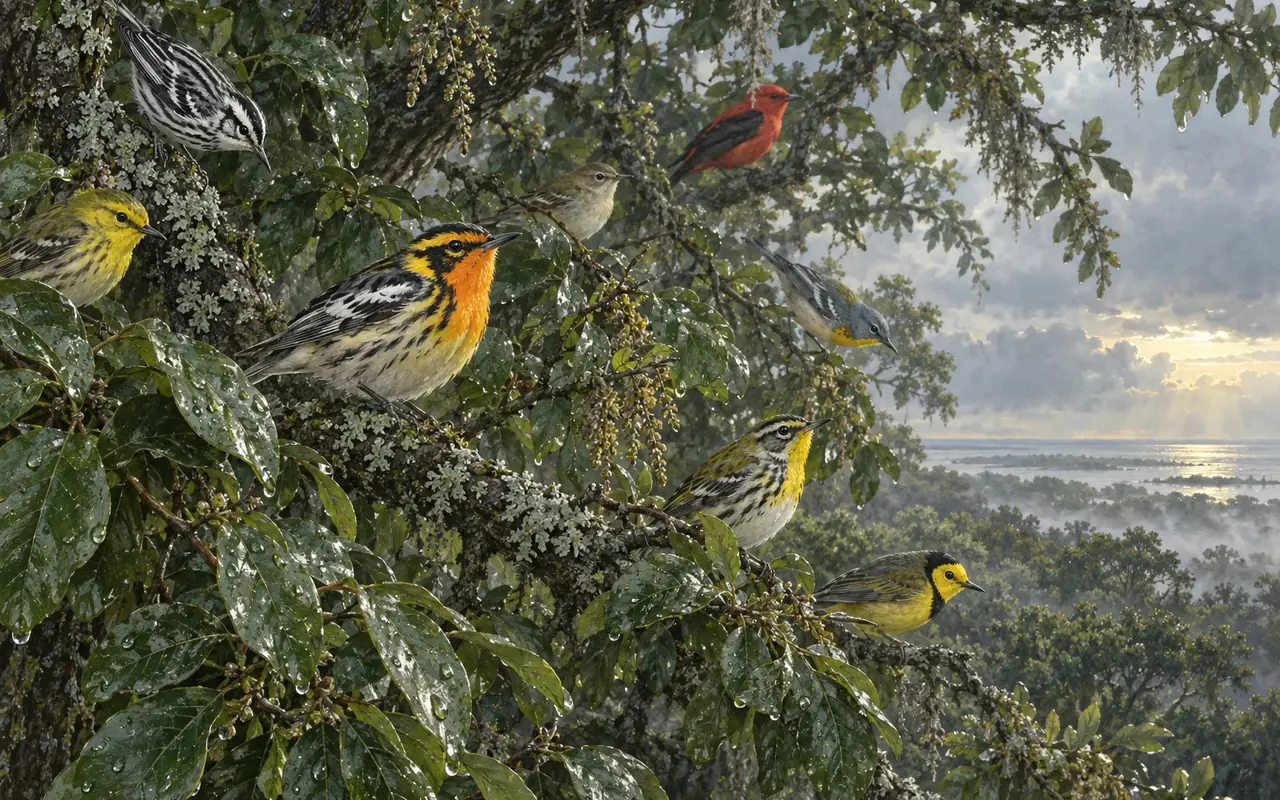
Birds that left the Yucatán after dark arrive over Texas around lunchtime. What happens next is decided by the weather over the water.
High Island is a salt dome a mile inland of the Gulf with live oaks growing on top of it, in a coastal prairie that has almost no other trees. Songbirds leaving the Yucatán after sunset reach the upper Texas coast in the middle of the following day; in fair weather most of them cross the beach with fuel to spare and carry straight on inland, and in bad weather they come down into the first cover they can see. That is why this is one of the few places in North American birding where the afternoon matters more than the dawn. Twenty-five miles southwest, at the far end of the Bolivar Peninsula, a jetty built in the 1890s has been accumulating a tidal flat ever since, and it now carries more than a hundred thousand shorebirds a year. Three days here are three overlapping spectacles running on three different clocks — the front, the nesting calendar and the tide — and the plan below is built to be reordered the night before.
At a glance
Planning the trip
- Give it
- Three days, and expect to spend them differently. The woods are a weather event and the other two spectacles are not, so a trip built around one perfect afternoon is a trip that can miss entirely. Three days gives you three rolls at a front, and the rookery and the flats carry the days in between.
- Base in
- Winnie, eighteen miles north on State Route 124 and about twenty-two minutes from the sanctuaries — a small crossroads town on I-10 with more rooms than anywhere else close. Crystal Beach is the coastal alternative, twenty minutes down the peninsula from High Island and twelve from Bolivar Flats, which flips the geometry if you expect to spend more time on the beach than in the woods. High Island itself is a village; do not plan on finding a room, a meal or a pharmacy there.
- Fly into
- Houston Bush (IAH) or Hobby (HOU), ninety and eighty-five miles respectively, and just under two hours either way, with Hobby marginally the easier drive out. Beaumont–Port Arthur (BPT) is only an hour away but serves very few routes — check what actually flies there before you build a trip around it.
- Car
- Required, and not only for the distance. There is no transit of any kind, the two halves of the trip are twenty-five miles apart, and the whole method depends on being able to change your mind at eleven in the morning.
- Scope
- Strongly recommended, and almost entirely for Bolivar. The woods are a binocular place at ten feet, and a scope is a liability on a crowded boardwalk. The flats are a scope place at four hundred yards, and without one a good deal of what is standing out there stays an unresolved grey line.
- Difficulty
- Easy at High Island: the sanctuaries are small, flat and largely boardwalked. Bolivar is harder than it looks — the walk from the vehicle barrier out along the flats is loose dry sand with no shade, and it is longer coming back.
- Book ahead
- Rooms in Winnie or Crystal Beach for late April, as early as you can manage. The sanctuaries take no bookings and you buy the pass at the gate. The ferry cannot be booked at all, which is the point of the warning below.
Natural history
Why this window
Trans-Gulf migrants leave the Yucatán Peninsula after dark and fly north over roughly six hundred miles of open water. Birds Houston puts the crossing at about eighteen hours in good conditions, which means the leading birds raise the Texas coast in the middle of the day rather than at first light. In fair weather they do not stop. They cross the beach high, with fuel in hand, and keep going inland until nightfall, and the coastal woods stay quiet all morning and most of the afternoon. Everything that makes High Island famous depends on that arrangement being interrupted.
What interrupts it is weather over the water. A strong, fast-moving cold front that crosses the coast and pushes out into the Gulf around the middle of the day puts a headwind, and often a wall of rain, in front of birds that have been flying since dusk. They burn their reserves against it and come down into the first cover they can reach — which on this coast means a handful of live-oak mottes standing in open prairie. The word for it is a fallout, and it is worth saying plainly that fallouts are uncommon. Most April days at High Island are not fallouts; they are good birding in a place where the birds are unusually close and unusually low. The difference between a good day and a famous one is a weather system, and nobody can promise you one.
That is why the trip stands on three legs rather than one. The rookery at Smith Oaks runs on a nesting calendar and ignores the weather entirely: Great Egrets start displaying in March, and by the middle of April there are eggs hatching, nests being built and birds courting all at once, on an island a stone's throw from a walkway. Bolivar Flats runs on the tide. Between them they make a trip that is worth taking in a flat calm — and the woods, on the day the front arrives, make it one you will still be describing in ten years.
The plan
Three days, in the order the sky and the tide hand them to you
These are three conditions, not days one, two and three. Read the forecast and the tide table the night before and take whichever fits tomorrow; over three days you will most likely use one of them twice. The only fixed rule is the one the birds set — on this coast the arrival is in the afternoon, so do not plan on being finished by lunch.
The day you came for
A cold front or a line of rain reaches the Gulf
Cancel everything else. A front pushing offshore in the middle of the day is the entire event, it happens in the afternoon, and it can be over by dark. Stay on the salt dome from late morning until they close the gates.
-
07:00Dawn
Let the radar do the planning
Sunrise runs from just before seven at the start of the window to about half past six at the end of it, and on this particular morning you do not need to be out for it. Spend the first hour on the Houston/Galveston forecast discussion and on radar: what you want to know is when the front will cross the coast and how far out into the Gulf it will get. A front that clears the beach before dawn has already done its work on birds that are still six hours out. A front that crosses between ten and two is the one that produces the afternoon everybody talks about.
-
10:30Daylight
Be in the woods before the birds are
Boy Scout Woods, and take the bleachers at Purkey's Pond if there is room. Arriving ahead of the weather matters for an unglamorous reason: the parking lot fills, and on a genuine fallout day it fills completely. Get parked, pay, and then let the front come to you. If it is already raining, sit it out under the shelter rather than going back to the car — the arrival often starts while the rain is still falling.
-
13:00Afternoon
Walk the loops slowly, then walk them again
Birds keep arriving for hours, in waves, and the composition of a given thicket turns over completely between two o'clock and four. Most people walk the loop once and stand still afterwards. Walk it repeatedly and slowly, watch the water features, and look at the ground as much as the canopy: exhausted birds feed low, and a fallout produces thrushes and waterthrushes walking about in the open where nothing normally walks.
-
15:30Afternoon
Change woods, not activity
Smith Oaks is a hundred and seventy-seven acres against Boy Scout Woods' sixty, and by mid-afternoon on a big day the difference in elbow room is the difference between seeing birds and seeing backs of heads. Work the drips — Don's Drip, Norma's Niche, Katrina's Corner — and give each of them twenty minutes rather than two. The rookery will still be there tomorrow; the fallout will not.
-
18:00Dusk
Stay until they turn you out
The sanctuaries are open dawn to dusk and sunset in this window is between twenty to eight and five to eight. The last hour of a fallout day is frequently the best of it: the light goes flat and gold, the crowd thins to a dozen people, and the birds that have been feeding all afternoon come down to drink. This is the hour to be at a water feature and not walking.
The ordinary day, and there will be more of these
Clear sky and a steady wind out of the south
The birds crossed high and kept going, and the woods hold residue from earlier in the week and not much else. This is not a bad day; it is a different day. Spend it on the coast and on the rookery, and come back for the afternoon anyway.
-
SunriseDawn
Ninety minutes in the woods, and be honest about it
Boy Scout Woods first, because it is small enough to read quickly. What you are doing is taking the temperature: if the drips are busy and there are birds on the ground, the woods are holding something and you should stay. If ninety minutes produces a handful of Northern Cardinals and a White-eyed Vireo, that is your answer. Go to the coast.
-
08:30Travel
State Route 87 southwest to Bolivar
Twenty-five miles and about thirty-five minutes, following the peninsula the whole way with the Gulf on your left and East Bay on your right. Buy a beach parking sticker before you need it — the shops on the peninsula sell them, and the Chamber of Commerce on Highway 87 in Crystal Beach is on the way. Turn down Rettilon Road to the beach, then right along the shore to the vehicle barrier, and park there.
-
09:15Daylight
Bolivar Flats, on whatever tide you have
Walk west from the barrier along the wet sand. The flats run out towards the North Jetty and the birds distribute themselves according to the water: on a falling or low tide they are spread out and feeding, which is good for variety and hard on the eyes; as the water comes up they bunch into roosts, which is good for counting and the moment when your presence matters most. Set the scope up once, well back, and let the flock settle rather than walking into it.
-
11:30Break
Horseshoe Marsh, ten minutes away
Six hundred and fifty acres of salt marsh and wet coastal prairie round a shallow lagoon, on Loop 108 by the lighthouse, with a boardwalk a fifth of a mile long through the middle of it. Nobody goes. It is the best place on the trip for Clapper Rail, Seaside Sparrow and the marsh birds that the flats do not hold, and it is free.
-
13:30Afternoon
Back to the salt dome, and the rookery first
The canopy walkway at Smith Oaks ends above Claybottom Pond and the birds are close enough that the problem is framing, not reach. Give it an hour, then move into the woods for the last three hours of daylight. Migrants arrive in the afternoon whether or not the weather made them stop, and a fair-weather day still drops a trickle into the oaks between four and dusk.
The morning after
Behind the front, or overcast with a north or east wind
Yesterday's arrivals are still here and they are hungry, and cool cloudy air keeps them low and feeding. This is the one condition where the woods really are best at first light, and the one morning worth getting up for.
-
SunriseDawn
Boy Scout Woods, and stand at the water
Grounded birds spend the first hours eating and the next ones drinking, and on the morning after a front the drips and ponds do the work for you. Purkey's Pond, Prothonotary Pond and the small drips along the boardwalk are the whole strategy. Stay put and let the woods rotate past you rather than chasing reports around the loop.
-
08:30Daylight
Smith Oaks — the woods, not the rookery
Most of the crowd walks straight through Smith Oaks to the canopy walkway and the pond, which leaves the oaks themselves comparatively quiet at exactly the hour they are most productive. Work the trails between the drips. The rookery is not going anywhere and the light on it is better later.
-
10:30Break
The three small ones, when the crowd arrives
Eubanks Woods on Old Mexico Road, S.E. Gast Red Bay at 7th and Kane Lane, and Hooks Woods on 1st Street. Between them they cover about twenty acres, your High Island pass admits you to all three, and on a busy morning you may well have them to yourself. This is also the civilised hour to spend money: the honour boxes take cash or a check, and buying the patch is the single easiest thing a visitor can do for these woods.
-
13:00Afternoon
Rookery or flats, and let the tide decide
If the tide is doing something useful at Bolivar this afternoon — dropping out to expose the flats, or pushing in to concentrate the roosts — go. It is thirty-five minutes and the light is behind you in the afternoon, which matters more on a beach than anywhere else on this trip. If the tide is flat and going nowhere, stay on the dome, take the rookery in good light and finish in the oaks.
Ground
Where to bird
Five places. Three of them sit within a mile of each other on the salt dome at High Island, and two are twenty-five miles southwest at the end of the peninsula. That gap is the single most important fact in planning a day here, which is why the map below is mostly road and water. Winnie, where you will probably sleep, is eighteen miles north of the top of the frame.
-
01
Boy Scout Woods
2088 5th Street, High Island · visitor parking at 5th and Dunman
$10 day pass · $35 annual patch Late morning to closing on a front; first light the day after one
Sixty acres of woods, coastal prairie and wetland a mile from the Gulf, and the sanctuary most people mean when they say High Island. The bleachers at Purkey's Pond are the most famous seats in American birding — rows of them facing a drip, with fifty people sitting in silence and a Kentucky Warbler bathing eight feet away. Boardwalks run through most of the property, which is why this is the one sanctuary a wheelchair user can do properly. The photo blind here is the only place on any Birds Houston property where flash is permitted. Volunteers staff the kiosk daily from mid-March to early May; at other times the honour box on the kiosk takes cash or a check.
-
02
Smith Oaks and the rookery at Claybottom Pond
Winnie Street entrance year-round · Old Mexico Road gate seasonal
$10 day pass · $35 annual patch The oaks early, the rookery in the flatter light of late afternoon
A hundred and seventy-seven acres, which makes it the largest of the High Island sanctuaries and the one you can walk in for a while without meeting anybody. Three drips — Don's Drip, Norma's Niche, Katrina's Corner — each have benches, and each can hold a morning on its own. The Kathrine G. McGovern Canopy Walkway runs seven hundred feet through the tops of the oaks on an accessible ramp and comes out above Claybottom Pond, where Roseate Spoonbills, Great and Snowy Egrets, Tricolored and Little Blue Herons, White Ibis and Neotropic Cormorants nest on a small horseshoe-shaped island; the colony has passed a thousand pairs in its best years. The alligators in the pond are the reason it works, because they keep raccoons and coyotes off the island. The two entrances are not interchangeable: Winnie Street is open all year and holds the year-round parking lot, while the Old Mexico Road gate is seasonal and Birds Houston's own pages have carried different dates for it — check before you rely on it.
-
03
Eubanks Woods, S.E. Gast Red Bay and Hooks Woods
Old Mexico Road, 7th at Kane Lane, and 1st Street · all within the village
Same pass · dawn to dusk Whenever Boy Scout Woods has a crowd standing in it
Three small properties scattered across the same salt dome — nine and a half acres, eight and a half, and two — and the reason to know them is arithmetic. On a good day at High Island the woods hold more birders than birds, and a single Cerulean Warbler over a drip at Boy Scout Woods can have forty people underneath it. These three have the same trees, the same water and almost nobody in them. Eubanks Woods and Red Bay belong to Birds Houston; Hooks Woods belongs to the Texas Ornithological Society and is managed by Birds Houston, your High Island pass covers it, and the walk-in gate on 1st Street is never locked. Park on the south side of the street, and keep out of the gardens — this is a village of a few hundred people who have been extremely patient for a very long time.
-
04
Bolivar Flats Shorebird Sanctuary
Rettilon Road off State Route 87 · 25 miles, 35 minutes from High Island
$10 county beach sticker Whatever the tide is doing — see the note below on why there is no best one
The North Jetty went up at the mouth of Galveston Bay in the 1890s, the currents changed, and sediment has been piling up behind it ever since; what it built is thirteen hundred acres of mudflat, salt marsh, beach and coastal prairie that carries more than a hundred thousand shorebirds a year and has been a Western Hemisphere Shorebird Reserve Network site since 1992. Turn down Rettilon Road to the beach, turn right, and drive along the sand to the line of posts — the vehicle barrier, which keeps cars off the nesting and roosting ground. Park there and walk. A county beach sticker is required for parking between Rettilon Road and the barrier, and a scope is close to essential.
-
05
Horseshoe Marsh Bird Sanctuary
Loop 108 opposite 23rd Street, by the Bolivar lighthouse
Free · daylight hours Any tide; best with the sun behind you
Six hundred and fifty acres of salt marsh and wet coastal prairie around a shallow tidal lagoon, ten minutes from the flats and reached off Loop 108 rather than the highway, which makes the turn a good deal safer. A boardwalk a fifth of a mile long runs into the middle of it. Almost nobody stops, and it holds the birds the open beach does not: Clapper Rail, Seaside Sparrow, Long-billed Curlew, oystercatchers and Gull-billed Terns over the lagoon, with Roseate Spoonbills feeding out in the lagoon. It is free, and it is the best half-hour on the peninsula that costs nothing.
The list
What to look for
Three different things are happening here and they do not reward the same behaviour, so it is worth keeping them apart. The woods are the famous part and the unreliable part: on a fallout day they are the best songbird watching in the United States, and on a fair-weather day they are pleasant and thin. The rookery is the opposite — it is on, every day, all window, regardless of the sky. The flats fall between the two and answer to the tide rather than the weather. And a word about the birds people travel for: Cerulean, Golden-winged and Cape May Warblers all occur here and none of them is likely on any particular morning. They are the bonus, not the plan.
The woods, when the weather decides
- Hooded Warbler Setophaga citrina
- Among the earliest of them and among the most dependable, and a bird of the understory everywhere, which here means eye level over a drip. If one species is going to be in the woods in the second week of April, it is this one.
- Kentucky Warbler Geothlypis formosa
- A skulker that walks rather than hops, and a bird most people know as a song from a ravine. At High Island it comes out to bathe in front of an audience, which is not how it behaves anywhere else in its range.
- Worm-eating Warbler Helmitheros vermivorum
- Works hanging clusters of dead leaves and nothing else, so once you know the habit you can find it deliberately rather than waiting for it. Regular here, scarce almost everywhere.
- Swainson's Thrush Catharus ustulatus
- The commonest of the Catharus thrushes through the middle of the window, usually on the ground under the oaks. A morning with thrushes walking in the open is the clearest sign you have arrived after weather.
- Scarlet Tanager Piranga olivacea
- Worth the trip on its own in the last ten days of April. Summer Tanagers are here too and in most years are commoner; the two together on one branch is one of the standard High Island photographs, and the reason is that both are exhausted.
- Rose-breasted Grosbeak Pheucticus ludovicianus
- Arrives in numbers from the middle of the window and behaves better than most — it sits still and eats, often at the top of a hackberry where you can actually see it.
- Indigo Bunting Passerina cyanea
- In big arrivals they come down in loose flocks and feed on the ground and along the edges in the open. Painted Buntings turn up in the same weeks and in far smaller numbers.
- Cerulean Warbler Setophaga cerulea
- Here is the honest note. Cerulean, Golden-winged and Cape May are the birds that people plan trips around, all three are genuinely possible in this window, and most visitors go home without them. Treat any of them as a gift and build nothing on it.
The rookery, which keeps its own calendar
- Roseate Spoonbill Platalea ajaja
- The reason the walkway exists. In April they are in full breeding colour — carmine shoulders, a buff wash on the neck — and they are nest-building and feeding young a short distance from the platform, in the open, all day.
- Neotropic Cormorant Nannopterum brasilianum
- Nests in numbers on the same island and is worth ten minutes even if you think you know cormorants: in breeding condition the white border behind the gape is sharp and the white filoplumes on the neck are obvious at this range.
- Anhinga Anhinga anhinga
- Fewer, and less reliable than the rest of the colony, but a regular presence over Claybottom Pond and unmistakable overhead — the flight silhouette is a cross with a tail.
- Great Egret Ardea alba
- The species that starts the season: displaying in March, so by April the earliest pairs have hatched young while others are still building. Seeing every stage at once on one island is the point of the place.
- Tricolored Heron Egretta tricolor
- Nests alongside Snowy Egret, Little Blue Heron, Cattle Egret and White Ibis, all of which are in the colony and none of which you will have to work for. The Little Blues in their first spring are the pied ones, which surprises people every year.
The flats, which keep to the tide
- American Avocet Recurvirostra americana
- Often the first thing you resolve through the scope, and in April many are in rusty breeding plumage. Black-necked Stilts are on the same water in smaller numbers.
- Marbled Godwit Limosa fedoa
- Dependable on the flats through the window, and the bird that teaches you the scale of the place: a flock that looks like brown gravel at four hundred yards resolves into two hundred godwits.
- Long-billed Curlew Numenius americanus
- The largest shorebird in North America and never really common, but Bolivar and the marsh behind it are as good a place as any in the country to expect one. Whimbrel pass through in the same weeks.
- Red Knot Calidris canutus
- Northbound through late April and early May, and some are already in brick-red breeding plumage. Numbers vary enormously from day to day and year to year — this is a bird to hope for rather than expect.
- Wilson's Plover Charadrius wilsonia
- Breeds on the beach here, which is the whole reason for the symbolic fencing and the vehicle barrier. Snowy and Piping Plovers are on the same sand, and all of them are nearly invisible until they move.
- Black Skimmer Rynchops niger
- Loafs on the flats in tight black-and-white ranks and feeds along the wet edge at close range. American Oystercatchers, dowitchers, peeps and four or five species of tern are in the same view, which is an argument for setting up a scope and staying put.
Practical
Know before you go
Reading the weather
This is the whole skill and it is decided the night before. What you are looking for in the Houston/Galveston forecast is a cold front reaching the coast and pushing out over the water in the middle of the day, ideally with rain along it. That is the arrangement that puts a headwind in front of birds that are already twelve hours out from the Yucatán. A steady southerly for days on end means they are crossing high and going inland, and the woods will be quiet no matter how early you get there. Nothing about this can be booked in advance, which is the argument for three days rather than one.
What it costs, and when the gates are open
The High Island sanctuaries belong to Birds Houston — the trade name the Houston Audubon Society now uses, so older books and signs say Houston Audubon and mean the same organisation. Admission at the time of writing is $10 for a day pass, students free, or $35 for an annual patch that admits one person to all five High Island sanctuaries for the year, Hooks Woods included. Membership of Birds Houston does not include admission. Kiosks are staffed only during spring migration; otherwise there are red honour boxes taking cash or a check, on the kiosk at Boy Scout Woods and near the canopy walkway entrance at Smith Oaks. The four Birds Houston sanctuaries are open dawn to dusk, every day. Prices and gate dates change: check the visitor page before you travel.
The tide, and why nobody will tell you the best one
Because there is no best one, only a trade. A low tide exposes the maximum area of flat and the birds spread out over it to feed, which is good for variety and hard work at range. A rising or high tide pushes them off the feeding ground into dense roosts, which is good for counting and for photographs and is also the moment when a person walking up the beach does the most damage. Two things about Bolivar make this more awkward than it sounds. The range is tiny — NOAA's Port Bolivar gauge gives a great diurnal range of about one and a half feet — so the difference between states of tide is subtle on the ground. And the tide here is often diurnal, one high and one low in a day, which means the useful water can fall at any hour at all. Across this window in 2027 fewer than a quarter of the low tides land between five and ten in the morning. Read the table for your actual dates and plan the day around it, rather than assuming a convenient dawn low.
Tired birds: how to behave in the woods
This matters more here than almost anywhere, because the birds that make High Island famous are the ones that nearly did not make it. A bird that has just crossed six hundred miles of water against a headwind has no reserve left to spend on you. Birds Houston's rules are unambiguous and they exist for that reason: no recordings, no bird calls, no pishing, no laser pointers, and no flash outside the photo blind at Boy Scout Woods. No drones. Stay on the marked trails and boardwalks, walk rather than cycle, leave the dog at home, and do not block a boardwalk with a tripod — on a fallout day the boardwalk is the only way past. Beyond the rules there is the ordinary courtesy of the place: step back and let people in, give directions out loud, and if forty people are pressed round one thicket, go and find another. There are two hundred and fifty acres of sanctuary here and most of the crowd is standing on two of them.
The beach: how to behave at Bolivar
Drive only as far as the vehicle barrier and then walk — the barrier is there because tires compact the sand, kill the invertebrates and crush the nests of birds that lay on open ground. Walk on the wet sand rather than through the dry, which is where the nests are, and stay outside the symbolic fencing wherever it has been put up; it marks nesting areas, and Wilson's, Snowy and Piping Plovers all lay here. Keep well back from roosting flocks and let the scope do the approaching. Never flush a flock, and be clear with yourself about what flushing is: if the birds lift, you were too close, and you have cost a bird that has flown from Argentina a meal it needed. Do not walk into the vegetated dunes and marsh behind the beach — nests, and snakes. No fires.
Crowds, parking and the ferry
High Island in late April is the busiest small place in American birding, and the Boy Scout Woods parking lot fills first and completely; if it is full, Smith Oaks has more room at the Winnie Street entrance and is a better place to be anyway. Arriving before the weather rather than after it is the single most useful piece of parking advice. As for the Galveston–Port Bolivar ferry: it is free, it runs around the clock, the crossing is 2.7 miles and takes about eighteen minutes plus loading, and in the season the queue can run past two hours. Do not build a time-sensitive morning on it. If you are coming from Galveston and need to be at High Island at dawn, drive round through Winnie and accept the extra mileage, or sleep on the right side of the water. TxDOT posts live wait times.
Getting around on foot
The two halves of this trip are very different. Boy Scout Woods has extensive boardwalks and Birds Houston states plainly that they make birding possible for wheelchair users; the canopy walkway at Smith Oaks has an accessible entrance ramp and seven hundred feet of level boardwalk ending above the rookery, which means the single best spectacle of the trip is also the most accessible thing in it. Bolivar is the opposite. From the vehicle barrier it is a long walk over loose dry sand with no shade, no path and no bench, and there is no short version: the birds are out where the flat is. Chairs and wheeled carts are not allowed in the sanctuaries, though wheelchairs, walkers and strollers are.
Heat, insects and the things that bite
Late April on the upper Texas coast averages the high seventies by day with nights in the sixties, and the humidity makes both feel warmer; on the beach there is no shade at all, so carry more water than you think and something with a brim. Thunderstorms build fast, and the sensible response to lightning is the car, not the picnic shelter. Mosquitoes in the woods after rain are genuinely serious rather than merely annoying — repellent, and long sleeves. Fire ant mounds are everywhere off the boardwalk and are the commonest actual injury here; watch where you put a tripod leg and where you stand. There are alligators in Claybottom Pond and cottonmouths in the wet margins, both of which are easy to avoid by staying on the trail, and wet boardwalk is slippery. Services are thin: fuel up in Winnie or Crystal Beach rather than assuming High Island has a pump.
Photography
The birds are unusually close, so the usual constraint is not reach but ethics and queueing. Flash is forbidden everywhere except the photo blind at Boy Scout Woods. At the rookery platforms during spring, Birds Houston asks photographers to limit their time at the front of the platform to twenty minutes, which exists because a long lens on a tripod at the rail can otherwise hold the best view for an hour. Portrait and other non-nature photography needs a permit. The rookery faces its best light late in the day; the flats work best in the afternoon with the sun behind you as you look west along the beach.
Sources
Admission prices, gate dates, beach sticker rules and ferry waits all change, and at Bolivar the beach itself changes. Confirm against the official pages before you travel, and read the tide table for your own dates rather than anybody's summary of it.
- Birds Houston — High Island visitor information
- Birds Houston — Spring coastal migration and fallouts
- Birds Houston — Boy Scout Woods
- Birds Houston — Smith Oaks
- Birds Houston — The rookery at Claybottom Pond
- Birds Houston — Bolivar Flats Shorebird Sanctuary
- Birds Houston — Horseshoe Marsh Bird Sanctuary
- Birds Houston — Sanctuary rules and policies
- Galveston County — Bolivar beach parking stickers
- TxDOT — Galveston–Port Bolivar ferry
- NOAA Tides & Currents — Port Bolivar, station 8771328
- National Weather Service — Houston/Galveston
- US Fish & Wildlife Service — Jocelyn Nungaray National Wildlife Refuge
Last reviewed 21 September 2026