Birding window
Magee Marsh
Three mornings on the last land before the lake
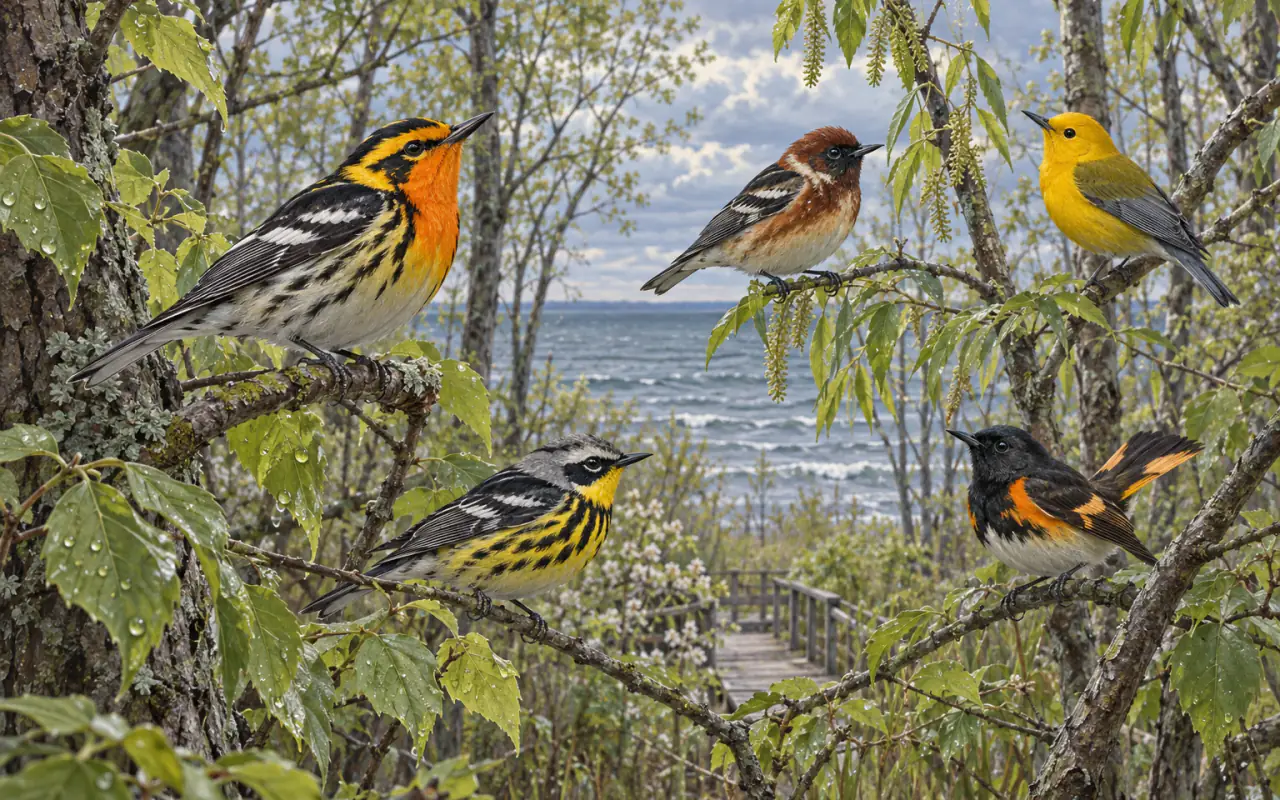
A few acres of beach-ridge woodland, thirty miles of open water, and every warbler that has to choose between them.
Magee Marsh is a low sand ridge on the south shore of western Lake Erie with a mile of boardwalk laid through the scrub on top of it. Migrants coming north overnight reach the lake at first light, find thirty miles of water in front of them and almost no other cover behind them, and stop. Between the seventh and the eighteenth of May that arrangement produces the most concentrated warbler watching in North America, and the largest crowd of birders on the continent standing in it. This is a plan for three mornings, built to be reordered the night before, when you can see what the wind is going to do.
At a glance
Planning the trip
- Give it
- Three mornings, and do not spend them all on the boardwalk. The composition of the woods turns over every day or two, so one morning is a sample and three is a picture. Anyone promising you a particular date is guessing; what you are actually buying with the extra days is the chance that one of them falls after a good night of flight.
- Base in
- Port Clinton, about twenty minutes east, or Oregon and the eastern edge of Toledo, about twenty minutes west. Oak Harbor sits between them, ten minutes inland, and is the smallest and quietest of the three. Maumee Bay Lodge in Oregon is the Biggest Week's headquarters, which makes it convenient during the festival and impossible to book late.
- Fly into
- Detroit (DTW) is the practical airport — roughly fifty miles and an hour, with the widest schedule of the three. Cleveland (CLE) is about ninety miles and an hour and a half. Toledo Express (TOL) is closest at forty miles but has very few flights. All three need a car.
- Car
- Yes, and it is not optional. The sites are strung along twenty miles of State Route 2 with no transit between them, and the whole point of the plan is being able to change your mind at half past five in the morning.
- Difficulty
- Easy. The Magee boardwalk and the loop behind the Ottawa visitor centre are flat and wheelchair accessible, and the Ottawa Wildlife Drive is birded from the car. The hard parts are social and ornithological: crowds, and warblers moving fast through new leaves in flat grey light.
- Book ahead
- Lodging, and much earlier than feels reasonable. The Biggest Week in American Birding runs 7 to 16 May 2027 — ten of this window's twelve days — and fills rooms across three counties. Nothing here needs a ticket: the boardwalk, the refuge and the marshes are all free and open to anyone, festival or not.
Natural history
Why this window
Northwest Ohio used to be the Great Black Swamp, and for the most part it is now drained farmland. What survives along the lake is a thin line of marsh and, running through it, a sand ridge thrown up by a larger ancestral Lake Erie. The ridge is the only high, dry, wooded ground for miles, and Magee Marsh's bird trail runs along a few acres of it. A migrant arriving at this shoreline is choosing between a hedgerow in a bean field and this — which is why the birds are not spread out, and why they are at eye level.
Songbirds move at night, on south winds, and come down before dawn. What happens next is decided by the weather. A warm southerly morning, and the birds that landed keep going: they refuel and cross the lake at dusk, and the woods can be half empty by ten. A cold front, a north wind or rain at daybreak, and nobody crosses — the birds already on the ridge stay put, new arrivals pile in behind them, and because cold air holds insects low, the whole crowd feeds in the shrubs at the rail rather than in the canopy. The famous Magee mornings are not simply big arrivals; they are arrivals that cannot leave.
That is the case for several mornings rather than one perfect date. Species composition shifts across the second week of May — the early warblers thin out, Magnolia, Bay-breasted and Blackpoll build, the thrushes and flycatchers arrive behind them — and any single day can be dealt a clear warm night with nothing grounded. Check BirdCast's migration forecast and the overnight wind the evening before, decide in the evening, and keep the other two mornings in reserve.
The plan
Three mornings, in whatever order the wind allows
These are three modes, not days one, two and three. Each evening look at the overnight forecast and the migration forecast, decide which of them tomorrow is, and run that one. Two cold mornings in a row is not a wasted trip — it is the same woods with a different set of birds in it.
A heavy flight, then the wind turns
South wind overnight, north or north-west by dawn
The morning everything is arranged around. Birds came in on the southerly and now cannot leave. Be at the boardwalk before it is properly light, and stay longer than you meant to.
-
Sunrise −15 minDawn
The boardwalk, from the west entrance
Sunrise is between ten past and twenty past six in this window. The west parking lot is the first to fill, so take it while you can; if it is gone, the middle and east lots put you on the same loop from the other end. The first hour is the quietest the boardwalk will be all day and the birds are lowest while the air is still cold. The numbers etched into the top handrail are how everyone here reports a bird — learn to read them early.
-
08:00Daylight
Keep going round, slowly
The loop is about a mile and most people walk it in one direction and then leave. Walk it again. Warblers work through in waves and a stretch that held nothing at half past six can be full at eight. This is also when the boardwalk fills; if you hit a wall of people, go around it rather than through it and let the birds come back to you.
-
10:30Break
Out to the beach and the estuary trail
Walk north off the boardwalk to the Lake Erie beach for a look at the water and the shoreline scrub, then take the Crane Creek Estuary Trail east from the parking area. Both are part of the same wildlife area, both hold migrants, and neither has anybody on it. The tower at the Sportsmen's Migratory Bird Center, back down the causeway, is worth ten minutes for the view over the marsh.
-
13:00Daylight
Ottawa's trails, on foot
Half a mile west. The boardwalk loop behind the visitor centre is short, accessible and often good; the longer dikes beyond it give you marsh, open water and a genuine chance of quiet. If the Wildlife Drive is running that day, save it for the light at the end of the afternoon.
-
18:00 to duskDusk
Back to the boardwalk
Late afternoon empties the boardwalk of people and refills it with birds feeding hard before dark. On the evening of a good day you may also watch the departure: birds climbing out over the lake as the light goes, which is the other half of the story and almost nobody stays for it.
Cold, grey, wind off the water
Nothing new arrived, and everything is low
No flight overnight, so no new birds — but yesterday's cannot leave either, and cold pins the insects and the warblers into the bottom six feet of the woods. The best photography of the trip and the closest looks.
-
SunriseDawn
The boardwalk again, and unhurried
Resist the urge to go somewhere else because it is raining. A cold, wet, still morning at Magee is the one that puts a Blackburnian in a buttonbush at four feet. Waterproofs, and something to keep the optics dry; there is no shelter on the boardwalk and the lake wind goes straight through a fleece.
-
09:30Daylight
Metzger Marsh, down the causeway
Fifteen minutes west. Drive the paved causeway out into the marsh and use the pull-offs — open water on one side, marsh on the other, terns and herons over both. At the end of the road there is a small woodlot that catches migrants in exactly the way Magee's ridge does, at about one per cent of the attendance.
-
12:30Break
Dry out, and look at the forecast
Oak Harbor and Port Clinton are both close enough for lunch. Use the hour to check the overnight wind and the migration forecast for tonight, because that decides which of these three mornings you run tomorrow.
-
14:00Daylight
Howard Marsh, for the open ground
Nearly a thousand acres of restored coastal wetland with dike-top trails across it, and completely different birds from the boardwalk: ducks, waders, terns, marsh birds and, when the water is drawn down, shorebirds on the mud. The wind that makes the woods miserable makes no difference here. Note that it opens at seven, which is after sunrise — this is an afternoon site in May, not a dawn one.
Warm, southerly, clear
The woods empty out by mid-morning
Good flying weather means birds leave. There may be a fresh arrival at first light, but it will thin fast, and by ten the boardwalk is mostly people. The answer is to stop looking for warblers in trees and go and look at water and savanna instead.
-
SunriseDawn
One early hour on the boardwalk
Take the first hour anyway — on a warm morning it is the whole of the day's songbird passage, and it is the emptiest the boardwalk ever gets. Then leave without arguing with yourself about it.
-
08:00Daylight
Ottawa, and the Wildlife Drive if it is open
The seven-mile drive leaves from the visitor centre entrance road and runs sunrise to an hour before sunset, but only on posted dates — in recent years it has run through most of May, and it is worth telephoning the refuge to confirm rather than assuming. From the car you get bitterns, rails calling, terns, herons and whatever shorebirds the pool levels have exposed, and the car is a better hide than anything you could build.
-
11:30Travel
Inland, to the oak savanna at Oak Openings
Forty-five minutes south-west, free, open from seven until dark, and a different state entirely. Oak Openings Preserve is five thousand acres of black oak savanna, sand barrens and wet prairie on the dunes of a vanished lake, and an Audubon Important Bird Area in its own right. Girdham Road between Reed and Monclova is the stretch to walk: Ohio's only dependable Lark Sparrows, along with Red-headed Woodpeckers, Summer Tanagers and Blue-winged Warblers, none of which occur on the lakeshore at all.
-
16:00Daylight
Pearson, on the way back
A surviving fragment of the Great Black Swamp on the eastern edge of Toledo — wet woods, a viewing window, and a restored wetland in the newer northern section. It is twenty minutes from your bed and it is where to spend a last hour when you have run out of ambition but not daylight.
Ground
Where to bird
Five places strung along twenty miles of State Route 2, none of them more than half an hour from the next, covering between them every condition these three days can throw at you. A sixth — the oak savanna at Oak Openings, forty-five minutes inland and off the map below — belongs to the third morning and is described there. This is not the region's full list of hotspots and is not meant to be.
-
01
Magee Marsh Wildlife Area
13229 W State Route 2, Oak Harbor · the bird trail
Free · sunrise to sunset First light, and again in the last two hours
The anchor, and rightly so: about a mile of boardwalk looping through a few acres of woodland on the beach ridge, with three parking lots along the causeway and numbered handrails so that a bird can be reported precisely. It is also the busiest piece of birding ground in the country during the festival. The rest of the wildlife area is quieter and barely visited — the causeway pull-offs, the Lake Erie beach, the Crane Creek Estuary Trail and the observation tower at the Sportsmen's Migratory Bird Center. The visitor centre keeps extended hours, eight to four daily, from late April to mid-May.
-
02
Ottawa National Wildlife Refuge
14000 W State Route 2, Oak Harbor · half a mile west of Magee
Free · drive on posted dates Mid-morning onward, and late light on the drive
Five thousand acres of managed marsh next door, and the best relief valve when the boardwalk is shoulder to shoulder. The short boardwalk loop behind the visitor centre is ADA compliant and open year-round; the dike trails beyond it are long, exposed and empty. The seven-mile Wildlife Drive is the draw, but it opens only on posted dates and closes an hour before sunset, so check the refuge's schedule or call before you plan a morning around it. Satellite navigation has a habit of sending people to Krause Road, three miles west of the entrance.
-
03
Metzger Marsh Wildlife Area
12600 Bono Rd, Bono · the causeway
Free · daylight hours Any time; the woodlot is best early
A paved causeway runs north from Bono Road across five hundred acres of deepwater marsh to a parking area, a fishing pier and a small woodlot at the lake's edge. The pull-offs along it give you marsh on one side and open water on the other without leaving the car, and the woodlot at the end is a genuine migrant trap that almost nobody walks. Watch the traffic when you stop; the causeway is narrow and people drive it faster than they should.
-
04
Howard Marsh Metropark
611 S Howard Rd, Curtice · dike trails
Free · opens 7 a.m. Mid-morning to evening
A thousand acres of farmland returned to coastal wetland in 2018 and extended west of Howard Road since, with five miles of dike-top trail and two overlooks. This is the water-and-mud half of the trip — ducks, terns, herons, marsh birds, and shorebirds wherever the levels have been drawn down. It is open, exposed and unaffected by the wind that ruins the woods. The seven o'clock opening is after sunrise in May, so treat it as a site for the rest of the day.
-
05
Pearson Metropark
761 Lallendorf Rd, Oregon · swamp woods and Pearson North
Free · opens 7 a.m. Late afternoon, on the way back
One of the last surviving pieces of the Great Black Swamp, on the edge of Toledo: wet woods, a covered viewing window onto feeders, and a restored wetland in the newer section north of Starr Avenue. It has none of Magee's concentration and none of its crowd either, and it is the closest real birding to the western lodging, which makes it the natural last hour of a long day.
The list
What to look for
Two things are worth saying plainly. Magee's reputation rests on how close the common migrants come, not on rarity — the ordinary warblers at six feet are the event. And the birds people arrive hoping for are, with one or two exceptions, birds of the days after this window ends. Nothing below is a guarantee, and no honest count exists for a morning you have not had yet.
What the window is built on
- Magnolia Warbler Setophaga magnolia
- Often the commonest warbler of the middle of the window, and one of the tamest. On a cold morning they work the buttonbush at the rail, at a range where binoculars are the wrong tool.
- American Redstart Setophaga ruticilla
- Everywhere from the second week on, and impossible to lose track of — it flushes insects by flashing the orange in its tail, which means it never holds still and never stops being visible.
- Blackburnian Warbler Setophaga fusca
- A canopy bird almost everywhere else in its range. Here the canopy is twenty feet up and the weather regularly brings it down to ten, which is the whole argument for this place.
- Bay-breasted Warbler Setophaga castanea
- A late-window bird that builds through the second week of May. Slow, deliberate and given to feeding low in cold weather; one of the species that makes the eleventh to the eighteenth better than the seventh.
- Prothonotary Warbler Protonotaria citrea
- The one that is not passing through. It breeds in the flooded willows at Magee and Ottawa, so it is on territory and singing for the whole window rather than moving on overnight.
- Swainson's Thrush Catharus ustulatus
- The bird on the ground under the boardwalk while everyone is looking up. Numbers peak across exactly these dates, and a cold morning puts them out in the open on the trail edges.
Worth going somewhere specific for
- Blackpoll Warbler Setophaga striata
- The tail end of the warbler procession, arriving as the others peak. Scarce on the seventh, common by the eighteenth — a decent index of how late in the window you have come.
- Cape May Warbler Setophaga tigrina
- Irruptive, and tied to spruce budworm far to the north. Some springs there are dozens along the boardwalk and some springs you work for one; neither says anything about how good your morning was.
- American Bittern Botaurus lentiginosus
- Ottawa and Howard Marsh, usually as a bird that flies up out of the cattails fifty yards from where you were looking. Listen for the pumping call at dawn and dusk more than you look.
- Black Tern Chlidonias niger
- Over the open marsh at Metzger, Ottawa and Howard — a declining bird that western Lake Erie still holds. Best seen from a causeway or a dike, not from inside a wood.
- Lark Sparrow Chondestes grammacus
- The reason to give up a morning on the lakeshore. Ohio's only reliable breeding population, on the sand barrens along Girdham Road, and there is nothing like it anywhere on the lakeshore.
- Summer Tanager Piranga rubra
- Also the Oak Openings savanna, and far more dependable there than the scattered spring overshoots that turn up on the lake. Listen for the call before you look for the colour.
Prizes, not promises
- Kirtland's Warbler Setophaga kirtlandii
- A handful pass through northwest Ohio each May on the way to the Michigan jack pines, and in most years at least one is found somewhere along this shore. Being present when that happens is luck, not planning. Do not build a trip on it.
- Connecticut Warbler Oporornis agilis
- Genuinely scarce here, skulking, and — the part people do not want to hear — peaking in the last week of May, after this window has closed. If it is the bird you came for, come later.
- Golden-winged Warbler Vermivora chrysoptera
- Annual in small numbers and steeply declining across its range, with hybridisation blurring the edges. A good find on any morning and never an expectation.
- Cerulean Warbler Setophaga cerulea
- Uncommon, high in the canopy when it does appear, and gone before most people get on it. The weather that drops everything else to eye level is your only real chance.
- Mourning Warbler Geothlypis philadelphia
- A late migrant and a ground skulker, most likely at the very end of the window and more likely after it. Found by voice, in tangles, by people standing still.
- Yellow-bellied Flycatcher Empidonax flaviventris
- The empids arrive behind the warblers and peak in late May. One in the second week is a good bird; a silent one is a photograph and an argument.
Practical
Know before you go
Reading the wind
This is the whole skill, and it is decided the night before. A south wind overnight means birds are moving and something will arrive. A wind that then swings north, or a front, or rain at dawn, means what arrived cannot leave. Warm, clear and southerly all night and into the morning means the woods will drain. BirdCast publishes a nightly migration forecast and live migration maps for the region; read it with the National Weather Service forecast for Toledo, and choose tomorrow's morning from the two together.
Crowds, and how to miss them
The Biggest Week draws tens of thousands of people to a mile of boardwalk. Weekends are the worst and the middle of the day is the worst of the day; Tuesday to Thursday is materially calmer. First light and the last two hours are the two windows when the boardwalk is both good and quiet. If you meet a wall of people, go around it rather than waiting it out — and remember that Ottawa, Metzger and Howard Marsh are minutes away and essentially empty all week.
On the boardwalk
Stay on it: the woodland either side is closed to foot traffic, and nobody here treats that as advisory. Step to the rail on the side the bird is on so people can pass behind you. Keep your voice down, silence your telephone, and do not sit on the railings. Pishing, squeaking and recorded playback are all discouraged here, and feeding or baiting birds is prohibited outright. Assistance animals only — no other pets. Share what you find; everyone here will share with you.
Photography
The birds are closer than your minimum focus distance at least once a trip. From 1 to 15 May tripods must be used as monopods on the boardwalk, and a tripod is the single most complained-about object on it in any case — if you use one, keep it inside half the boardwalk's width. Flash is discouraged where birds are close and people are packed. The edges of the parking lots are excellent, uncrowded and entirely tripod-legal.
Parking and the causeway
Three lots serve the boardwalk along the Magee causeway — west, middle and east — plus the visitor centre lot at the entrance. The west lot fills first and the lots can fill entirely on a festival weekend morning. Park only in the marked areas: no verges, no grass, no overnight. The three gravel pull-outs on the causeway are for birding the marsh, and are worth using on the way in and out.
Accessibility
Better than most birding of this quality. The Magee boardwalk is flat and wheelchair accessible for its whole length, as is the shorter boardwalk loop behind the Ottawa visitor centre. Ottawa's Wildlife Drive is birded entirely from the car on the days it is open, and Metzger's causeway works the same way. Howard Marsh's dike trails are level but long and completely unshaded.
Weather, clothing and insects
Expect anything between the mid-fifties and the mid-seventies Fahrenheit, and expect the lake to make it colder and windier than the forecast for Toledo suggests. Layers, waterproofs and something for the optics; there is no shelter on the boardwalk. Biting insects are usually not yet a problem this early — the mosquitoes and the marsh midges arrive in force later in May — but a warm spell can bring them forward, so carry repellent and do not be surprised.
Check what is open before you go
Hours and access here change from year to year and sometimes from week to week. The Ottawa Wildlife Drive runs only on posted dates and is weather-dependent; the metroparks open at seven rather than at dawn; the Magee visitor centre keeps extended hours in migration but not outside it; individual trails and boardwalks in the area have closed for repair more than once in recent years. Every site on this page is free, but confirm the current schedules with the refuge, the Division of Wildlife and Metroparks Toledo in the week before you travel.
Sources
Festival dates, drive schedules, park hours and trail closures all change from year to year. These are the bodies that manage the ground and publish the current position; check them before you travel rather than trusting this page.
- ODNR Division of Wildlife — Magee Marsh Wildlife Area
- Friends of Magee Marsh — visitor centre and wildlife area hours
- Black Swamp Bird Observatory
- The Biggest Week in American Birding
- Magee Marsh boardwalk code of ethics
- U.S. Fish & Wildlife Service — Ottawa NWR Wildlife Drive
- Metroparks Toledo — Howard Marsh Metropark
- Metroparks Toledo — spring migration
- BirdCast — migration forecasts and live maps
- National Weather Service — Cleveland forecast office
Last reviewed 21 September 2026