Birding window
The monsoon borderlands
Sky islands in a second spring
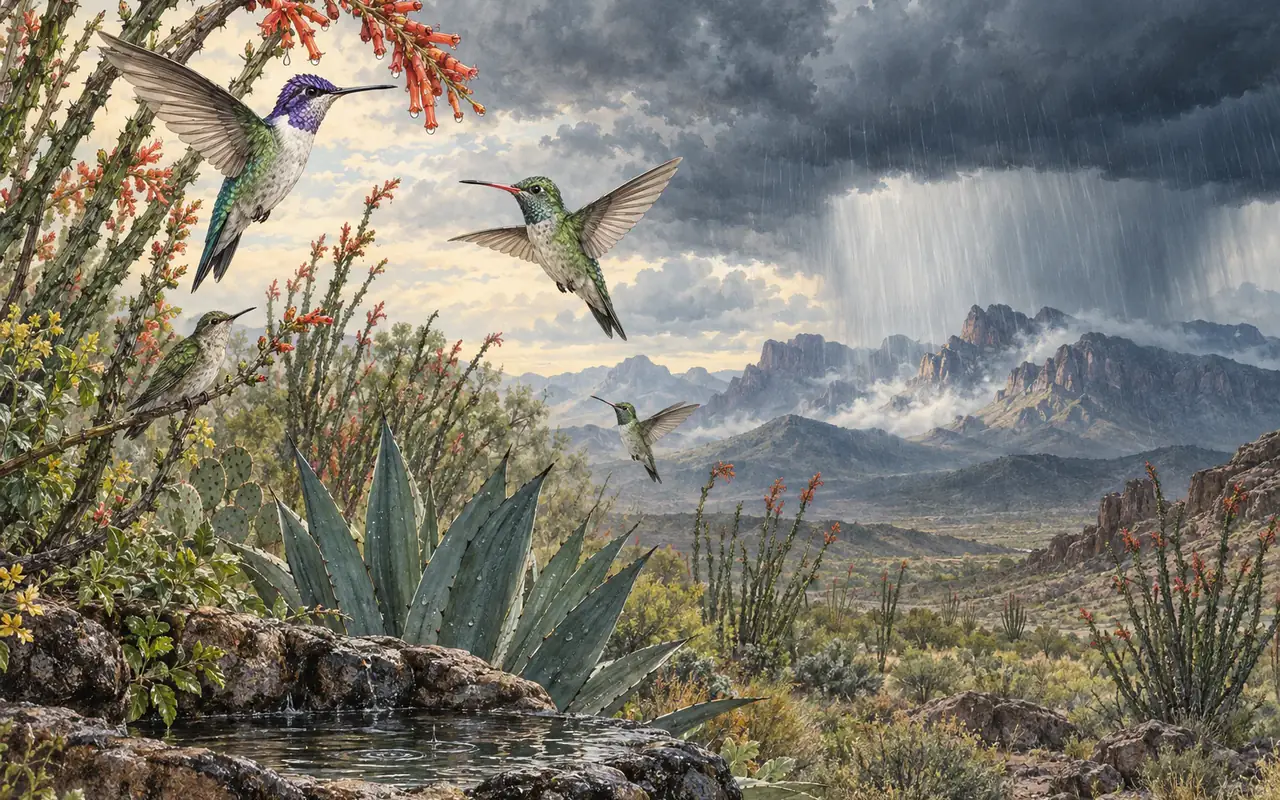
For six weeks after the first storms, the driest corner of the country runs a second breeding season. The hummingbirds are the headline; the grasslands are the surprise.
Southeastern Arizona is a scatter of forested mountain ranges standing in desert grassland, each one an island of oak and pine cut off from the next. When the summer rains arrive the whole system restarts: grasses green, insects hatch, sparrows that were silent in June sing again, and the canyons fill with more species of hummingbird than anywhere else in the United States. This is a plan for three days from one base, built around a day that has two good ends and a difficult middle.
At a glance
Planning the trip
- Give it
- Three days minimum, four or five if you can. One range is a sample; the point of the region is the differences between them. Arrive in time for an afternoon, because the first storms usually build after two o’clock.
- Base in
- Sierra Vista. The Huachuca canyons are twenty minutes away, the San Pedro River ten, the Sonoita grasslands forty, and Madera Canyon about ninety. Tucson is the alternative if you want city food and the Santa Catalinas, but it puts an hour onto every Huachuca dawn.
- Fly into
- Tucson (TUS) is the practical airport — about an hour and a quarter to Sierra Vista, and every rental company is on site. Phoenix (PHX) has far more flights and often lower fares, but it is roughly two hours to Tucson and three to Sierra Vista, through country you will not want to drive at the end of a long day.
- Car
- Essential, and think about clearance. The paved canyon roads are fine in anything; Carr Canyon and several grassland tracks are not, and monsoon rain rearranges dirt roads overnight. A standard rental will reach every site in this plan. Anything beyond it, ask locally first.
- Difficulty
- Easy to moderate on foot — most of the birding is along canyon roads, feeder gardens and short trails. The real difficulty is heat and elevation: you will start near 4,000 feet and may spend an afternoon at 8,000, in July, and dawn is the only cool hour of the day.
- Book ahead
- Less than the Platte, but not nothing. Lodging in Sierra Vista and Patagonia tightens sharply around the two August festivals. Ramsey Canyon Preserve has twenty-seven parking spaces and no roadside overflow, so it is first-come rather than bookable — arrive early or come back.
Natural history
Why this window
For most of the year this is a hot, thin-aired place where birds are concentrated wherever there is water. Then, usually in the first week of July, the wind turns around and pulls moisture up from the Gulf of California, and the region starts producing thunderstorms almost daily. Locals call what follows the second spring, and that is not a figure of speech: grasses that have been dormant since the last rains green within days, insect numbers go up by an order of magnitude, and a set of birds begins breeding for the first or second time that year.
The birding consequences are specific. Botteri’s and Cassin’s Sparrows, invisible and silent in a dry June, sing from every third yucca once the grass comes up. Flycatchers and orioles feed young. And the hummingbirds — the reason most people come — reach their annual peak, as post-breeding birds move down from the north, altitudinal wanderers come up out of Mexico, and every feeder garden in the Huachucas runs eight or ten species at once.
It also reshapes the day. Mornings are clear, cool by local standards, and full of song. By eleven the heat is genuinely punishing and the birds have gone quiet. By early afternoon the cumulus is stacking over the ranges, and between roughly two and six there is a good chance of a storm somewhere in view — often spectacular, occasionally dangerous, and almost always somewhere other than where you are standing.
The plan
Three days
Built from Sierra Vista and organised by geography: the Huachucas on your doorstep, the grasslands and Patagonia to the west, the Santa Ritas to the north-west. Every day has the same shape, because the weather insists on it — dawn, a long hot middle spent at feeders or asleep, and an afternoon you plan around the sky.
Day one
Arrive, and go up the nearest canyon
Travel day, kept local. Nothing here needs a reservation, and the Huachuca feeder gardens are the gentlest possible introduction to a region with a long species list.
-
By 14:00Travel
Tucson to Sierra Vista
Pick the car up, buy more water than you think you need, and drive south. Check in before you go birding — you will not want to be finding a hotel after dark, and the afternoon light is short once the cloud builds.
-
15:00Midday
Ash Canyon, and the hummingbird problem
The Southeastern Arizona Bird Observatory’s sanctuary on Spring Road, Hereford, is open dawn to dusk Friday through Wednesday and from noon on Thursdays, for a suggested ten-dollar adult donation. It is a garden with feeders, water features and viewing blinds, and it is probably the most accessible place in the United States to see a Lucifer Hummingbird. Sit down. Hummingbird gardens reward patience far more than they reward walking, and an hour in a chair here will teach you the common species you will need to know all week.
-
17:00Storms
Watch the sky from the San Pedro
Drive down to the San Pedro House on Highway 90 east of Sierra Vista — a cottonwood gallery along one of the last undammed desert rivers in the Southwest, free and open, and the best Gray Hawk country in the country. It is also open enough to see weather coming. If a cell is building over the Huachucas, this is a fine place to watch it from; if it is coming at you, the car is three hundred yards away.
-
19:30Night
Owls, quietly
Whiskered and Western Screech-Owls, Elf Owls and Mexican Whip-poor-wills all call from the lower canyon roads after dark, and you can hear them from a pull-off without walking anywhere. Use your ears rather than a speaker: playback is restricted or prohibited in Madera Canyon, at the Nature Conservancy preserves, in the South Fork of Cave Creek and on Fort Huachuca, and these are among the most heavily birded canyons in North America.
Day two
West to the grasslands and Patagonia
The day that justifies coming in the monsoon rather than in May. If the rains have been good, the grassland hour at dawn is the best hour of the trip.
-
SunriseDawn
Las Cienegas, while it is still cool
Forty minutes north-west on Highway 90 and 82 to the Bureau of Land Management’s Las Cienegas National Conservation Area — open, free, and one of the great remaining stretches of Sonoran semi-desert grassland. After rain this is where Botteri’s and Cassin’s Sparrows sing from the tops of things, with Grasshopper Sparrow, Eastern Meadowlark of the Chihuahuan form, Scaled Quail and Swainson’s Hawk around them. Drive the graded roads slowly with the windows down. If the grass is still brown, cut this short and go on.
-
09:30Midday
Patagonia: the Paton Center, then the creek
Half an hour south-west. The Paton Center for Hummingbirds, run by the Tucson Bird Alliance at 477 Pennsylvania Avenue, is a suburban back garden that has been welcoming birders for fifty years — free, open dawn to dusk, donations doing the work — and it is the single most dependable place in the country for Violet-crowned Hummingbird. Then the Nature Conservancy’s Patagonia-Sonoita Creek Preserve on Blue Heaven Road, $8 general and $5 for members and Cochise County residents, open Wednesday to Sunday from 6.30 a.m. in summer: cottonwood-willow gallery forest with Thick-billed Kingbird, Northern Beardless-Tyrannulet and, in some years, Rose-throated Becard.
-
13:00Break
Get out of the sun
Eat in Patagonia and do not fight the middle of the day. This is the hour when visiting birders make themselves ill; the shade temperature is beside the point when you are standing in a canyon with no breeze.
-
15:00Storms
The roadside rest, and whatever the weather does
The Patagonia Roadside Rest Area on Highway 82 is a scrap of pull-off with a genuinely absurd bird list, and a reasonable place to sit out a cell. Watch the ranges: if the Huachucas are already black, go back the long way. Roads flood at the dips, not at the high points, and the dips are unsigned.
-
SunsetDusk
Back through the grassland
The drive east on Highway 82 at last light is the region at its best — thunderheads lit from underneath, Lesser Nighthawks over the grass, Common Poorwills on the warm tarmac. Drive slowly. The poorwills are the reason.
Day three
North-west to Madera Canyon
The most famous canyon in the region, and worth the early start it demands. An hour and a half from Sierra Vista, so this is a dawn you begin in the dark.
-
Pre-dawnTravel
Leave in the dark
Madera Canyon is roughly ninety minutes from Sierra Vista. There is an $8 day-use fee for the Coronado National Forest, payable by card at the pay stations at the Proctor and Roundup lots or by cash or check at the fee boxes, and a $10 weekly or $40 annual Coronado pass is sold at the Santa Rita Lodge. Have a plan for payment before you arrive at six in the morning.
-
SunriseDawn
Walk the road for trogons
Elegant Trogons nest in the sycamores of the upper canyon, and the first two hours of light are when you will hear one — a low, barking series that carries much further than you expect. Walk the road between the upper lots rather than charging up a trail; the birds are along the drainage. Sulphur-bellied Flycatcher, Arizona Woodpecker, Painted Redstart, Mexican Jay, Bridled Titmouse and Hepatic Tanager all come with the same walk, and Montezuma Quail sometimes step onto the verge at first light.
-
09:30Midday
The Santa Rita Lodge feeders
Ten or more hummingbird species work the lodge feeders through the morning — Broad-billed, Rivoli’s, Blue-throated Mountain-gem, Black-chinned, Anna’s, Broad-tailed and the first southbound Rufous, with Calliope later in the season. The viewing area is free to sit in if you are watching rather than hiking. This is the other half of the region’s bargain: the hard birds take dawns, and the spectacular ones take a chair.
-
12:30Break
Down the hill and out of the heat
Lunch in Green Valley or back in Sierra Vista, then an hour off your feet. You have a night drive or a flight tomorrow and the afternoon belongs to the weather.
-
16:00Dusk
Ramsey or Miller, for the last of the light
Two Huachuca options, both small and both worth the whole trip. The Nature Conservancy’s Ramsey Canyon Preserve is $8, $5 for members and Cochise County residents, free under eighteen, open 8 a.m. to 5 p.m. and closed Tuesdays and Wednesdays — with twenty-seven parking spaces, first come, and no parking on the road below. Beatty’s Guest Ranch in Miller Canyon charges $5 a head for its feeder terraces. Both are places where the scarce Mexican hummingbirds turn up, and both are better in the last two hours of daylight than in the middle of the day.
Ground
Where to bird
Seven places covering three mountain ranges, one river and one grassland — enough for three days without driving past the birding to get to more of it.
-
01
Ramsey Canyon Preserve
27 E. Ramsey Canyon Rd, Hereford · Huachucas
Fee · 27 spaces Hummingbird diversity, and where the wanderers appear
The Nature Conservancy’s canyon, and the most reliable address in the country for White-eared and Berylline Hummingbirds when they are present at all. $8 general, $5 for members and Cochise County residents, free for ages 17 and under; open 8 a.m.–5 p.m. from 1 March to 31 October, closed Tuesdays and Wednesdays. Parking is twenty-seven spaces, first-come, with none permitted on the road below — the single most common way to waste a morning here.
-
02
Beatty’s Miller Canyon Guest Ranch
Miller Canyon Rd, Hereford · Huachucas
Small fee Feeder terraces at 5,800 feet
An orchard and guest ranch whose feeder terraces have recorded fifteen hummingbird species, White-eared and Berylline among them. $5 per person for day visitors. Parking is tight and reserved for guests and visitors with disabilities; the Forest Service lot below the ranch takes the overflow, and the walk up is short but steep.
-
03
Ash Canyon Bird Sanctuary
5255 E. Spring Rd, Hereford · Huachucas
Donation Lucifer Hummingbird, from a chair
Run by the Southeastern Arizona Bird Observatory: a hummingbird garden with five water features, public blinds and a photo blind. Open dawn to dusk Friday through Wednesday and noon to dusk Thursday, with a suggested $10 adult donation. Its signature bird is Lucifer Hummingbird, a species otherwise associated with west Texas, and this is the easiest place in the country to see one.
-
04
San Pedro House, SPRNCA
Highway 90 east of Sierra Vista · San Pedro River
Free Gray Hawk and cottonwood gallery, free and open
The main access point to the San Pedro Riparian National Conservation Area, a Globally Important Bird Area holding some forty per cent of the United States’ nesting Gray Hawks and over a hundred breeding species. Bureau of Land Management ground, free, with a bookshop and a hummingbird banding station running weekly sessions April to September. Easy, level trails through grassland and old farm fields to the river.
-
05
Las Cienegas National Conservation Area
Off Highway 82 near Sonoita · grassland
Free Grassland sparrows, once the rain has come
Forty-odd thousand acres of BLM semi-desert grassland and cienega, free and open, crossed by graded dirt roads that are fine in a car when dry and worth respecting when wet. This is the monsoon site on the list: Botteri’s and Cassin’s Sparrows only really declare themselves after the grass greens, and in a dry year there is not much point coming.
-
06
Patagonia: Paton Center & the creek preserve
477 Pennsylvania Ave and 150 Blue Heaven Rd, Patagonia
Free · donation Violet-crowned Hummingbird, and riparian specialties
Two sites ten minutes apart. The Tucson Bird Alliance’s Paton Center is a back garden open dawn to dusk, free with donations, and the country’s most dependable Violet-crowned Hummingbird. The Nature Conservancy’s Patagonia-Sonoita Creek Preserve is $8 general and $5 concessionary, open Wednesday to Sunday 6.30 a.m.–4 p.m. in summer, and holds Thick-billed Kingbird, Northern Beardless-Tyrannulet and Gray Hawk in mature cottonwood.
-
07
Madera Canyon
Madera Canyon Rd, Coronado NF · Santa Ritas
Day-use fee Elegant Trogon at dawn, feeders by mid-morning
The best-known canyon in the region and still the easiest place to connect with Elegant Trogon. An $8 per-vehicle day-use fee applies; electronic pay stations take cards at the Proctor and Roundup lots, and weekly ($10) and annual ($40) Coronado passes are sold at the Santa Rita Lodge. The lodge’s feeder viewing area is free if you are watching rather than hiking, and runs a dozen hummingbird feeders. Playback is restricted here.
The list
What to look for
The distinction that matters in this region is not rare against common, but dependable against reported. The first two groups are birds a careful visitor should expect in this window. The third are Mexican wanderers that appear in some years and not others; go and see one if it is being seen, and do not build a trip around it.
Dependable in this window
- Elegant Trogon Trogon elegans
- Nesting in canyon sycamores at Madera, South Fork and the Huachucas. Heard far more often than seen; the first two hours of light are the whole game.
- Rivoli’s Hummingbird Eugenes fulgens
- The big one at mid-elevation feeders, black-looking until the light catches the crown and throat.
- Blue-throated Mountain-gem Lampornis clemenciae
- Larger still, and loud. Ramsey, Miller and Madera all hold them through the summer.
- Broad-billed Hummingbird Cynanthus latirostris
- The default hummingbird of the lower canyons and gardens, and a useful size reference for everything else.
- Sulphur-bellied Flycatcher Myiodynastes luteiventris
- A summer visitor from the tropics, in sycamore canyons. The squeaky-toy call gives it away before you see the streaks.
- Arizona Woodpecker Dryobates arizonae
- Brown above rather than black, and restricted in the United States to these ranges. Oak woodland, often with Mexican Jay flocks.
Likely, with the right ground and hour
- Violet-crowned Hummingbird Leucolia violiceps
- Clean white underparts, red bill. The Paton Center in Patagonia is the reason this is in the second group and not the third.
- Lucifer Hummingbird Calothorax lucifer
- Decurved bill, long forked tail on the male. Ash Canyon is the address; it is a breeding-season bird, so earlier in the window is better.
- Montezuma Quail Cyrtonyx montezumae
- Walked past far more often than flushed. Grassy oak slopes and canyon verges at first light, and pure luck at any other hour.
- Botteri’s Sparrow Peucaea botterii
- The monsoon bird. Silent and untraceable in dry grass, conspicuous and singing from exposed perches within days of real rain.
- Varied Bunting Passerina versicolor
- Thorn scrub and canyon mouths; the male looks black until it turns. Box Canyon and the Patagonia roadside are traditional.
- Whiskered Screech-Owl Megascops trichopsis
- The common small owl of the oak canyons, in a Morse-code rhythm. Audible from a pull-off, which is how it should be found.
- Gray Hawk Buteo plagiatus
- Along the San Pedro and at Patagonia — a compact grey buteo of cottonwood galleries, with a whistled call.
Wanderers, not promises
- Berylline Hummingbird Saucerottia beryllina
- Some monsoons bring one or two, usually to a known Huachuca feeder garden, where they may linger for weeks. Many years bring none.
- White-eared Hummingbird Basilinna leucotis
- Similar story and similar addresses; Ramsey and Beatty’s are where the reports come from when there are reports.
- Plain-capped Starthroat Heliomaster constantii
- The scarcest of the three regular monsoon hummingbird prizes. If one is present it will be widely known within a day.
- Flame-colored Tanager Piranga bidentata
- A handful of records most years in the canyons, occasionally pairing with Western Tanager. Streaked back, dark ear patch.
- Buff-collared Nightjar Antrostomus ridgwayi
- A few traditional desert-canyon sites near the border, calling in an accelerating rattle. Scarce, local, and increasingly hard to access.
Practical
Know before you go
Heat and elevation
Valley temperatures in late July run to the upper nineties and the sun at this latitude and altitude is stronger than the number suggests. You will also move between about 3,800 feet on the San Pedro and 8,000 or more in the upper canyons in a single day. Carry far more water than seems reasonable, start at first light, and treat the middle of the day as unusable for anything but feeders and shade. Heat illness, not a missed bird, is what ruins these trips.
Storms, lightning and flash flooding
The National Weather Service dates the monsoon 15 June to 30 September. Storms build over the ranges in early afternoon and can be violent, and ridgelines and open grassland are the worst places to be under them — the Carr Canyon switchbacks and the Las Cienegas roads both put you somewhere you cannot leave quickly. Flash flooding is the greater danger: monsoon cells drop intense rain over small areas, so a dry wash can run hard from a storm you never saw. Never drive into moving water, and remember that the low crossings are rarely signed.
Roads and closures
Paved canyon roads are fine in any car. Carr Canyon is paved for about 1.4 miles and then a rugged dirt climb of six-odd more, high clearance recommended, and it closes for fire, flood and snow. The Chiricahua crossing over Onion Saddle to Rustler Park is unpaved and roughly April to November. Graded grassland roads soften quickly after rain. Check current Coronado National Forest conditions before committing to any dirt, and never on the strength of a map alone.
Crowds and booking
Two festivals fall inside this window — Southwest Wings in Sierra Vista in early August and the Southeast Arizona Birding Festival in Tucson the following week — and between them they fill lodging across both towns. Either join one, or book early, or come in the last ten days of July. The sites themselves rarely feel crowded except for Ramsey Canyon’s twenty-seven parking spaces, which are gone by mid-morning on a good weekend.
Border country
Much of this birding happens within twenty miles of Mexico, and you will pass Border Patrol checkpoints on Highways 90, 80 and 82. They are routine: slow down, answer where you are going, carry photo identification. Some traditional birding roads near the line are remote and occasionally closed; ask locally rather than relying on an older site guide. Fort Huachuca’s canyons are excellent and open to the public, but require photo ID at the gate, close after dark, and have their own rules including a ban on recordings.
Night birding, done properly
Owls and nightjars are a real part of this window, and these canyons are among the most heavily birded in North America. Playback is prohibited or restricted in Madera Canyon, at the Nature Conservancy preserves, in the South Fork Zoological and Botanical Area and on Fort Huachuca, and the American Birding Association’s code asks birders to limit recordings in heavily birded places and for locally scarce species generally. Listening from a pull-off works, costs the birds nothing, and is how most of these species are recorded anyway. Keep lights off the birds.
If it goes wrong
The failure mode here is a late or weak monsoon. If the grass is still brown, write off the grassland sparrows and spend the time in the canyons and at feeders, which run on water that somebody is putting out rather than water that fell. If a road is closed or a storm has parked over your range, move west: the Santa Ritas, the Huachucas and the Patagonias rarely all have weather at once, and they are within ninety minutes of each other. And if the hummingbird you came for is not being reported, go anyway — eight species at one feeder is the actual show.
Sources
Fees, hours and road conditions in this region change year to year, and feeder sites occasionally suspend feeding for disease control. Confirm against the official pages before you drive.
- The Nature Conservancy — Ramsey Canyon Preserve
- The Nature Conservancy — Patagonia-Sonoita Creek Preserve
- SABO — Ash Canyon Bird Sanctuary
- Tucson Bird Alliance — Paton Center for Hummingbirds
- Coronado National Forest — passes and permits
- BLM — San Pedro Riparian NCA
- National Weather Service Tucson — monsoon
- American Birding Association — Code of Birding Ethics
Last reviewed 21 September 2026